Teflon: The Refrigerant Accident That Made History
In 1938, chemist Roy Plunkett found a refrigerant had turned into a slippery mystery. How Teflon went from lab accident to wartime secret to kitchen staple.
Key takeaways
- In 1938, DuPont chemist Roy Plunkett discovered Teflon when a pressurized cylinder of tetrafluoroethylene gas polymerized inside its container, leaving a waxy white powder.
- The accidental polymer, polytetrafluoroethylene (PTFE), resisted heat, acids, and friction, with the lowest coefficient of friction of any manufactured substance at the time.
- Teflon's first large-scale use was a classified wartime secret: coatings on valves and seals handling corrosive uranium hexafluoride at Oak Ridge during the Manhattan Project.
- DuPont patented PTFE in 1941 and registered the Teflon trademark in 1945; by 1948 it produced more than two million pounds per year in Parkersburg, West Virginia.
- Nonstick cookware arrived decades later: coated muffin tins in the 1950s, and nonstick frying pans in the 1960s, made Teflon a household word.
On the morning of April 6, 1938, a DuPont chemist opened the valve on a pressurized gas cylinder and nothing came out — except the puzzle that would become Teflon. Roy Plunkett had been hunting for a safer refrigerant, not a revolution in materials. But the white, waxy substance he found inside that dead cylinder turned out to be one of the most chemically stubborn materials ever made: nearly immune to heat, acids, and friction. Within a few years it was a classified military secret; within a few decades it was in nearly every kitchen on Earth.
A Cylinder That Refused to Empty
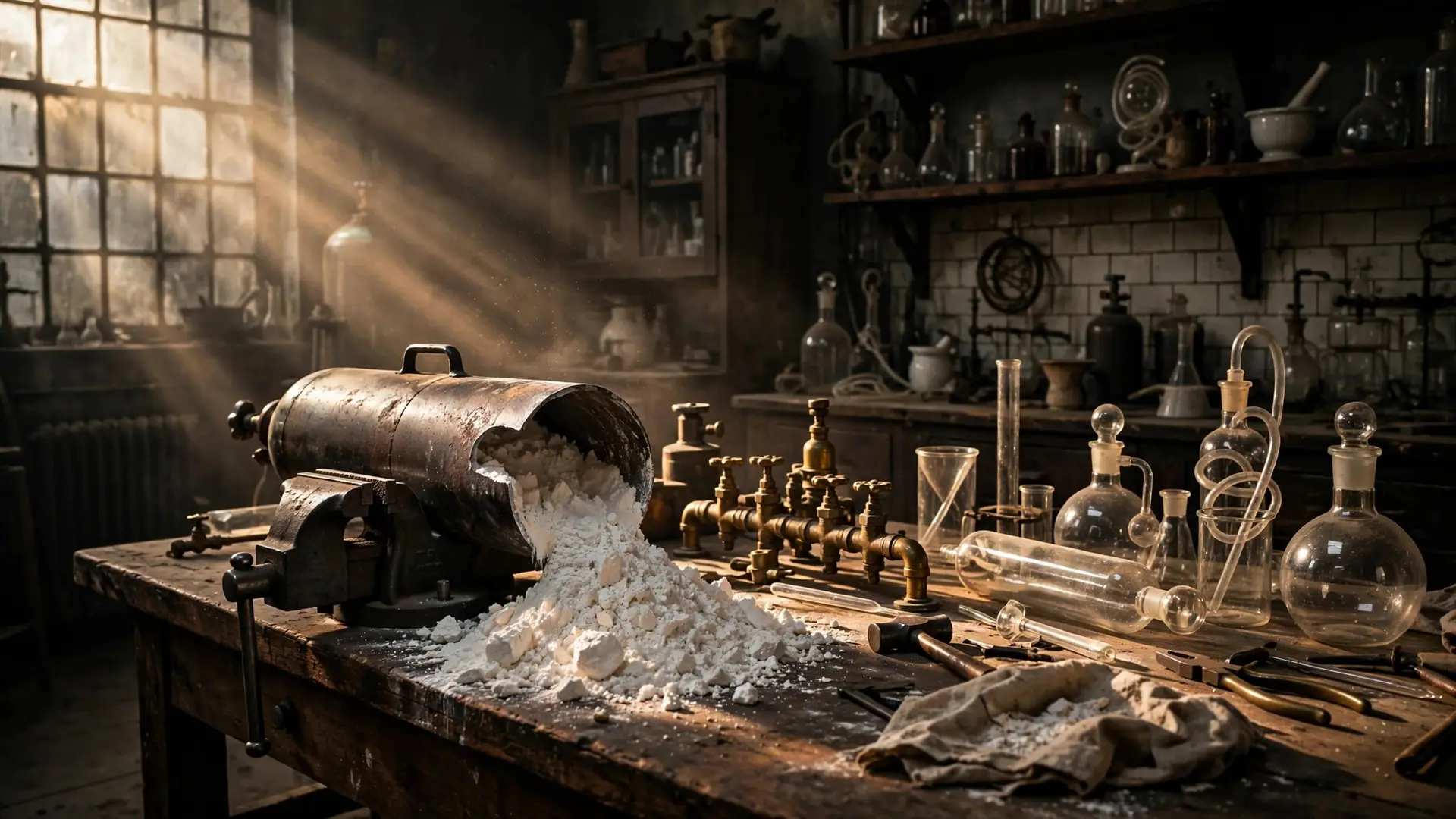
Plunkett worked at DuPont's Jackson Laboratory in Deepwater, New Jersey, on an assignment handed down by the refrigerator industry: develop new chlorofluorocarbon refrigerants to rival General Motors' Freon. His team had synthesized and frozen a batch of tetrafluoroethylene gas (TFE) in small steel cylinders for storage. When he and his assistant Jack Rebok went to use one, the valve released nothing — yet the cylinder was far too heavy to be empty. Rather than toss it aside, Plunkett weighed the anomaly. The two men shook the cylinder, prodded at it with a wire, and eventually did something that took some nerve: they sawed it open. Inside, the gas had vanished — and in its place sat a packed bed of white powder. Unknown to them, the TFE had polymerized inside the cylinder, with iron from the container's walls acting as a catalyst at high pressure, fusing the small molecules into the long chains of polytetrafluoroethylene, or PTFE. Plunkett immediately grasped that this was not just a ruined experiment. He later said his training had prepared him to recognize novelty. He set his scheduled refrigerant work aside and began testing the powder's properties: it was slipperier than graphite, untouched by strong acids, bases, and solvents, and astonishingly heat-resistant. DuPont patented the new fluorinated plastic in 1941 and registered the "Teflon" trademark in 1945 — "tef" for tetrafluoroethylene, plus a coined "lon" in DuPont's house style.
Too Slippery for Science to Ignore — and Too Expensive
For all its promise, PTFE nearly died in the lab. It was brutally expensive to manufacture and maddeningly hard to shape — it couldn't be molded or extruded with ordinary plastics techniques. At first, the researchers shelved it and went back to the refrigerant hunt. It had no obvious customer and no obvious use case, and for a brief moment it looked like one of history's elegant but pointless curiosities. What it did have was a property no other material could touch: it resisted virtually everything. It had the lowest coefficient of friction of any manufactured substance at the time and refused to corrode. That combination would soon find exactly one customer willing to pay any price — the United States government, at war. Ironically, the discoverer almost left the story before it began. Plunkett was promoted to chief chemist in 1939 and moved to other DuPont divisions, and the puzzling white powder was handed to Central Research, where other scientists took up the experiment. Meanwhile, by the 1950s chemists developed fluoropolymer copolymers that preserved most of PTFE's prized chemical and mechanical traits while being far easier to mold and extrude — the quiet engineering work that finally made the accident practical. Serendipity provided the material; sustained, unglamorous problem-solving provided the uses.
From Bomb Secret to Kitchen Shelf
When the Manhattan Project scaled up uranium enrichment at the K-25 gaseous diffusion plant in Oak Ridge, Tennessee, engineers faced a nightmare materials problem. They needed to pump uranium hexafluoride — an extremely reactive, corrosive gas — through miles of pipes and thousands of valves and seals. Almost nothing could survive contact with it. Teflon could.
So the accidental polymer became a classified asset. Its first large-scale application was as coatings on valves and seals in the uranium hexafluoride handling equipment at Oak Ridge — a military secret kept tightly under wraps until the war ended. By 1948, DuPont was producing more than two million pounds of Teflon-brand PTFE per year in Parkersburg, West Virginia, and chemists had begun developing related copolymers that were easier to mold, opening the door to practical applications. Domestic fame came later and more slowly. In the 1950s, coated muffin tins introduced Americans to the miracle of nonstick; in the 1960s, nonstick frying pans made Teflon a household word. From there it spread into gaskets, seals, cable insulation, cookware, and countless industrial parts. As Plunkett remarked in 1991, by then "there is no walk of life or industry, actually, that you don't run up against it." A discovery that had sat on a shelf became infrastructure.
The Nuance: Luck Favors the Prepared Lab
It's tempting to file Teflon under "pure luck" — and it does belong in the pantheon of accidental discoveries, alongside the kitchen microwave. But the full story resists the myth. The accident itself was genuinely unforeseeable: prevailing chemistry theory did not predict that TFE would polymerize the way it did. Yet nothing would have come of it had Plunkett ignored the weight discrepancy, discarded the cylinder, or lacked the training to recognize what the white powder was. There's also a quieter lesson about time horizons. Teflon was "discovered" in 1938 but was useless without a customer for seven years; it took the atomic bomb's extreme demands to drag it out of the lab, and two more decades to reach the frying pan. Breakthrough materials don't arrive when they're invented — they arrive when the world needs exactly what they do.
A Powder, a Bomb, and Your Frying Pan
Teflon began as a failure: a refrigerant that never made it out of the cylinder. It survived because a curious chemist stopped to ask why the math didn't add up, and because a war happened to need the one thing this substance did better than anything else on Earth. The next time an egg slides off your pan, you're watching the long tail of a sawed-open steel cylinder in New Jersey — proof that the best discoveries are often the ones nobody was looking for, in the hands of people ready to see them.
Frequently asked questions
How was Teflon discovered?
DuPont chemist Roy Plunkett was storing frozen tetrafluoroethylene gas in steel cylinders when one refused to empty. Sawing it open revealed a waxy white powder: the gas had polymerized into PTFE, with iron from the cylinder walls acting as a catalyst.
Why was Teflon a wartime secret?
Its first large-scale application was coating valves and seals that handled extremely corrosive uranium hexafluoride at the K-25 gaseous diffusion plant in Oak Ridge during the Manhattan Project. It stayed classified until the war ended.
When did Teflon reach home kitchens?
Domestic fame came in the 1950s with coated muffin tins, and in the 1960s nonstick frying pans made Teflon a household word.