Why Do Flamingos Balance and Sleep on One Leg?
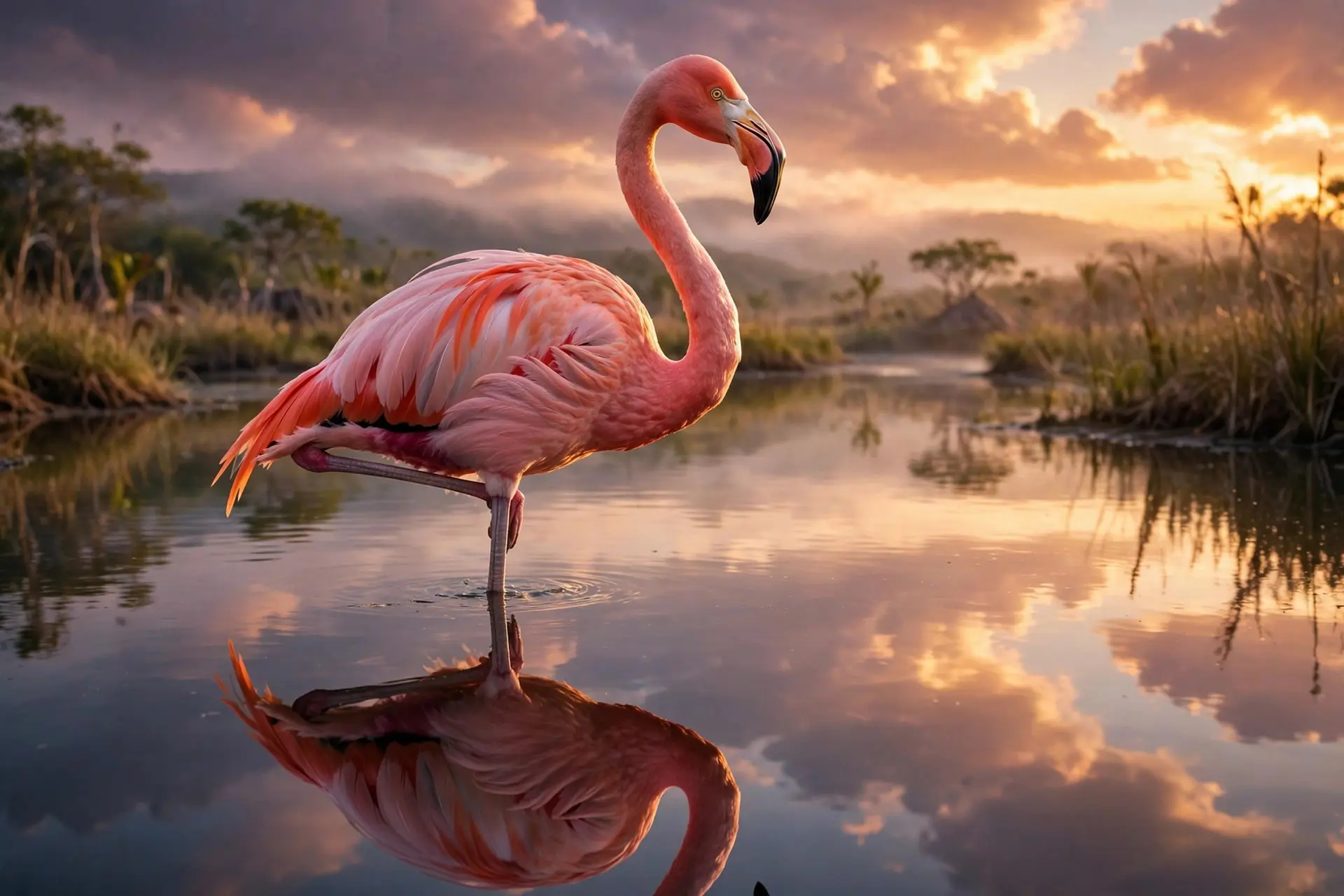
Why do flamingos rest on one leg? Their joints lock into the pose with almost no muscle effort, and tucking the second leg in conserves heat in cold water.
Key takeaways
- A 2017 study found flamingos balance on one leg using a 'passively engaged gravitational stay apparatus' that needs almost no muscle force.
- Even a dead flamingo's leg settles into a stable one-legged stance, showing the posture is held by joint mechanics and gravity, not active muscle.
- Live flamingos sway less when dozing on one leg than when awake — the opposite of what humans do with their eyes closed.
- Zoo observations show flamingos tuck a leg more often in colder air and water, supporting the theory that the stance conserves body heat.
Flamingos stand on one leg for two complementary reasons: their joints are built to lock into a one-legged stance with almost no muscle effort, and tucking the second leg against the body reduces heat loss when they rest in cold water. Scientists spent decades theorizing about it before a 2017 study revealed the bird's skeleton is essentially a passive balancing machine — the posture costs so little energy that flamingos may simply stand this way because it is the easiest option.
How can a flamingo balance on one leg without getting tired?
It looks like an athletic feat — a large bird held aloft by one spindly leg for hours — but it requires almost no work at all. In 2017, biomechanics researcher Young-Hui Chang of the Georgia Institute of Technology and neuromechanist Lena Ting of Emory University published a study in the journal Biology Letters describing what they called a "passively engaged gravitational stay apparatus." When a flamingo settles onto one leg, its body weight engages the hip and knee joints into a fixed configuration, and gravity does the rest. No active muscle contraction is needed to hold it. The researchers proved it in the most dramatic way possible: with a dead flamingo. When Chang positioned one of two cadaver birds vertically on a single leg, it collapsed into the exact posture of a resting flamingo and stayed there, stable even when nudged — despite having no living muscle activity whatsoever. As Chang described it, the mechanism is "more like a hammock or sling than a lock": the bird's specialized anatomy, its clever folded posture, and gravity combine into a structure that is stable by design. Crucially, it is posture-specific. The cadaver could not hold the same passive stability on two legs; unfold the leg, and the joints collapsed.
The live-bird tests were just as surprising. Ting and Chang tested eight juvenile Chilean flamingos from the Zoo Atlanta flock — one of the largest breeding flocks in the United States — on a force plate, an instrument that measures tiny body movements like a high-tech balance board. Awake birds swayed a little. But when a bird dozed off, the swaying dropped off dramatically. That is the exact opposite of humans: close your eyes while standing on one leg and your body sway increases sharply. For the flamingo, sleep appears to be when the posture settles into its most stable, lowest-effort form — which helps explain how the body times its own rest cycles without toppling over.
Why would birds tuck a leg into their body?
Before Chang and Ting's anatomical work, the leading explanation was about temperature. A flamingo's legs are long, bare, and often submerged in cool water — a perfect setup for losing heat. Tucking one leg up into the warm feathered body halves the exposed surface area, like pulling one hand into your coat pocket on a cold day. The evidence comes from careful zoo observation. Researchers at Philadelphia Zoo found that captive Caribbean flamingos stood on one leg significantly more often when air and water temperatures were lower — exactly the pattern you would expect if the posture helps limit heat loss. Earlier behavioral work found the same pattern: flamingos rested on one leg more frequently while standing in water than on land, and less often as temperatures rose. None of this contradicts the biomechanics. As Ting herself pointed out, the 2017 study is fully consistent with the heat-conservation theory: if standing on one leg costs the bird almost nothing energetically, then using that posture to stay warm is an excellent deal. Two adaptations — one anatomical, one behavioral — stack neatly on top of each other.
What was scientists' earlier understanding of the pose?
For a long time, there were two competing schools of thought about the purpose of one-legged standing: conserve heat, or rest tired muscles by letting one leg recover while the other worked. The muscle-fatigue theory took a direct hit from the 2017 findings. If the posture itself requires essentially no muscle activity, then there is no fatigue to recover from — nobody had even tested whether the stance was tiring before Chang and Ting's study, and it turned out it wasn't.
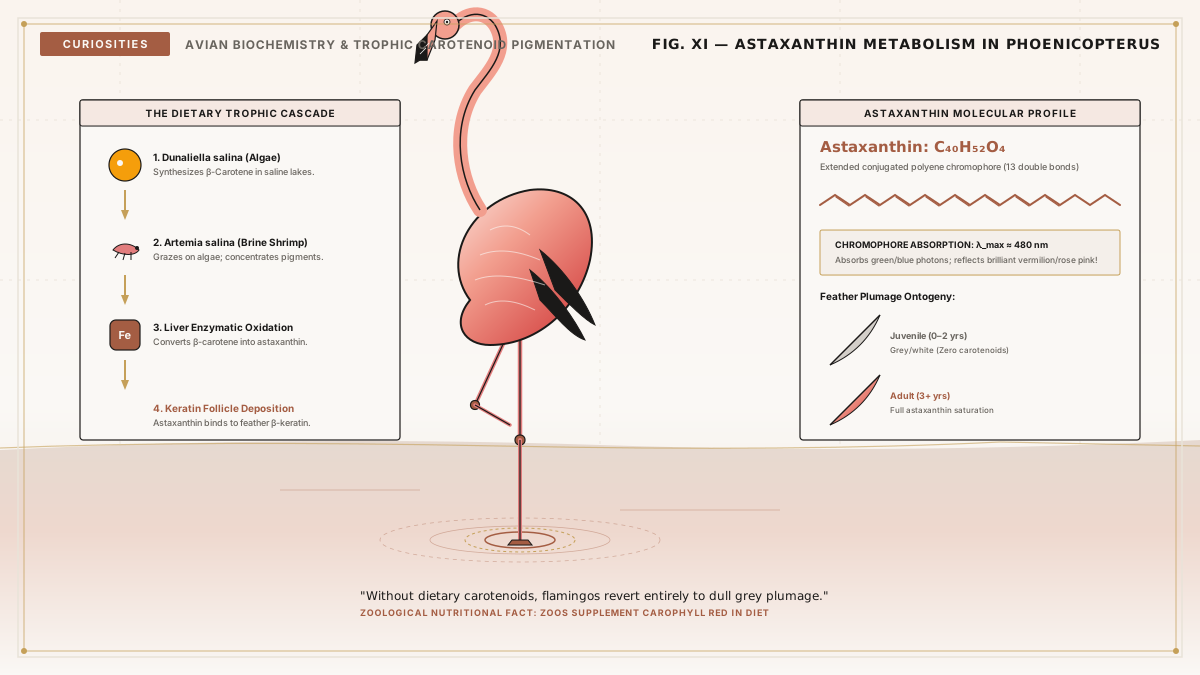
The anatomy holds another surprise for anyone watching a flamingo. The knobby joint in the middle of that long leg is not the knee at all — it is the ankle. The real knee and hip joints sit tucked up near the body, largely hidden beneath the wing feathers, with the thigh running almost horizontally. So the limb you see folded against the body is mostly shin and ankle, a compact package that keeps the bird's warm core insulated while its legless-down pose would be impossible for a creature whose skeleton didn't permit it. Flamingos are not the only birds that do this, either — wood ducks and storks also rest on one leg, and Ting has suggested the passive mechanism could be a more general trick used by many birds. But the flamingo, with its extreme height and famously thin legs, is the most dramatic showcase of it. Their world is an extreme one: six flamingo species live around shallow, often highly saline waters — salt pools, soda lakes, alkaline lagoons — and lesser flamingos in East Africa have been observed drinking from geyser-fed springs around 60 °C. Their tough, scaly leg skin shields them from the caustic water they stand in, and the striking pink of their feathers comes from the carotenoid pigments in the shrimp and algae they filter-feed on — a story told in our piece on why flamingo feathers turn pink. The one-legged stance is one more piece of that extreme-environment toolkit, alongside vision and senses as specialized as the mantis shrimp's.
Can flamingos really sleep while standing?
Yes — and they do it routinely. Like dolphins and some long-distance migratory birds, flamingos are thought to engage in unihemispheric slow-wave sleep, where one half of the brain sleeps while the other half stays alert enough to keep the bird standing. When the awake half needs its rest, the flamingo simply switches legs and settles back into its low-effort pose. Given that the one-legged stance needs virtually no active muscle control, sleeping upright becomes less a balancing act and more a default state. There is a safety logic to it as well. Sleeping standing upright in the middle of the flock, surrounded by thousands of other flamingos, is far safer for a bright-pink bird than settling onto unfamiliar ground — and the toxic, high-salinity water that predators avoid doubles as a moat. So the one-legged pose is, in the end, a pile of small advantages: it costs nothing to hold, it conserves heat, it enables sleep, and it keeps the bird out of predators' reach. Evolution rarely hands an animal a single perfect reason for anything. The flamingo's signature stance works because every part of the answer — bones, joints, gravity, behavior — fits together at once.
Frequently asked questions
Is the one-legged stance harder work than standing on two legs?
For flamingos, no. The 2017 research showed the passive stay mechanism works on one leg only — the birds could not hold the same passive balance on two legs.
Do flamingos ever switch which leg they stand on?
Yes. They alternate legs over time, just as people shift their weight. Resting one leg while balancing on the other is part of their normal resting behavior.
Is the flamingo's visible 'knee' really a knee?
No. The joint in the middle of the leg is the ankle. The true knee and hip are tucked up near the body, hidden under feathers, with the thigh nearly horizontal.