Why No Two Snowflakes Are Ever Exactly Alike
Each snowflake carries about a quintillion water molecules arranged by weather that never repeats. Here is why every one is a one-of-a-kind ice sculpture.
Key takeaways
- A single snowflake contains around a quintillion water molecules, and the number of ways they can arrange themselves is nearly infinite.
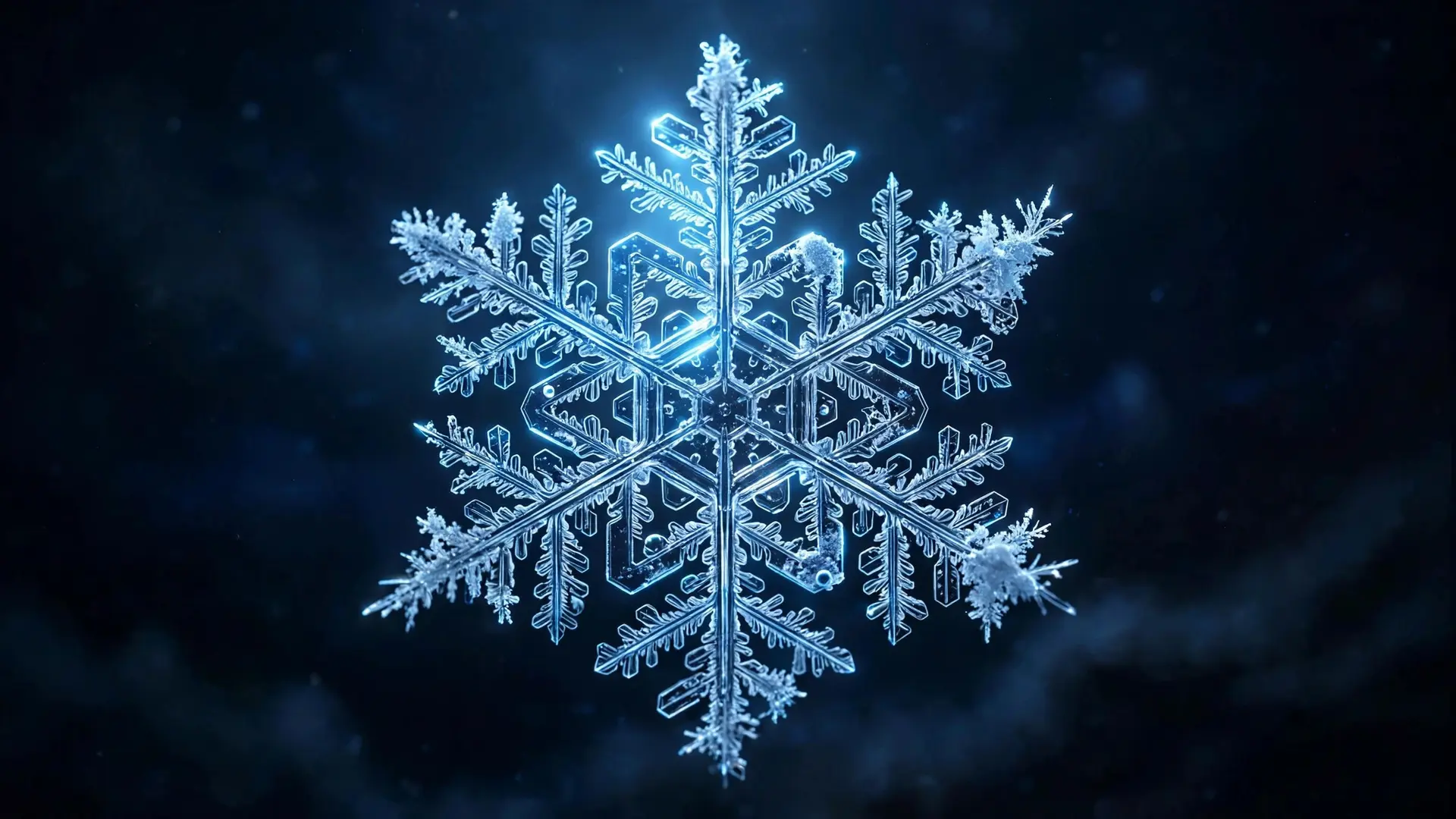
- Snowflakes always grow six-sided because water's hydrogen bonds lock into a hexagonal lattice when ice forms.
- All six arms of one flake match because they shared the same journey; no two flakes share a journey, so no two match.
- Tiny differences in temperature, humidity, and deuterium isotopes along each flake's fall guarantee uniqueness.
No two snowflakes are exactly alike — and that is not poetry, it is statistics. Every flake is assembled molecule by molecule from weather that never repeats, so each one lands on Earth as a design that will never be made again. Yet hidden inside this uniqueness is a stranger fact: the six arms of a single snowflake match each other almost perfectly. One flake, total symmetry; two flakes, total individuality.
Why do snowflakes always have six sides?
It starts with the shape of water itself. A water molecule — two hydrogen atoms joined to one oxygen — is slightly lopsided in charge: the oxygen end carries a small negative charge while the hydrogen ends are slightly positive. Because of this polarity, water molecules grip each other through hydrogen bonds, and when water freezes, each molecule locks onto four neighbors in a tetrahedral arrangement. That tetrahedral packing propagates into interconnected hexagonal rings, known as ice Ih — the form of ice found in nature. That hexagon is the snowflake's blueprint. Snow begins when water vapor undergoes nucleation: a handful of vapor molecules latch onto a microscopic solid surface, usually a fleck of dust or a grain of pollen, high in the clouds. The seed crystal that forms there carries the hexagonal symmetry of the ice lattice, and every water molecule that joins afterward must obey the same six-fold geometry. As one chemist puts it, nature allows only seven crystal systems, and snowflakes belong to the hexagonal one — the honeycomb system. So while each flake becomes wildly elaborate, it never escapes the hexagon it was born with. This is also the same quiet physics behind another frozen-water oddity: hot water can sometimes freeze faster than cold, a reminder that water's phase changes follow rules stranger than intuition suggests.
How does a snowflake's journey shape its design?
Once nucleated, the tiny crystal begins to fall, and falling is where the design gets written. As the flake drifts downward, more water vapor freezes onto its surfaces, and the new growth reflects the exact temperature and humidity of the air layer it is passing through. A flake might grow flat plates in one layer, then begin sprouting branches minutes later when the air around it changes — all while keeping its six-sided skeleton intact. Temperature acts as the master sculptor. Between roughly −2.8°C and 0°C (27–32°F), crystals grow as six-sided plates. A little colder, and the growth turns into needles; colder still, hollow columns; colder yet, the fernlike stars that snowflake photographers love. Humidity controls the intricacy: drier air encourages growth across flat surfaces, while moist air makes the tips, edges, and corners grow faster, producing elaborate branching. More water vapor in the air means faster, more intricate crystal growth overall. Here is the key to the mystery of matching arms: at the scale of a single falling flake, all six points experience the same air at the same time. Because the hexagonal seed preserves its symmetry as it grows, and because the vapor reaches every arm under nearly identical conditions, the six arms develop in near-perfect unison — each one a sibling of the others. The flake is essentially a flight recorder, and all six needles trace the same journey. That journey runs through the same restless atmosphere that spins up storms and steers hurricanes — except instead of destroying cities, the turbulence is carving ice.
What makes identical snowflakes essentially impossible?
The math is humbling. Snow scientist Charles Knight of the U.S. National Center for Atmospheric Research estimates that a single snow crystal holds around 10^18 water molecules — a quintillion of them. The number of ways those molecules can arrange themselves is, for practical purposes, infinite. Even if two flakes started as perfect twins, their paths diverge the instant they begin falling: slightly different temperatures, slightly different humidity, slightly different concentrations of water vapor, plus bumps, collisions, and branches breaking off along the way.
And the differences run deeper than shape. Water contains isotopes — heavier variants of hydrogen and oxygen. Deuterium, a heavy isotope of hydrogen, appears roughly once in every 5,000 to 6,500 hydrogen atoms. The exact count and placement of deuterium atoms varies from flake to flake, so even two crystals with visibly identical outlines differ at the molecular level. Then there is the seed: each flake forms around a differently shaped dust mote or pollen grain, so no two crystals even start alike. Think of it like identical twins with the same DNA. Begin with the same blueprint, then give each twin a slightly different life — different air, different weather, different seed. By landing time, they have become unmistakably different people. Even mid-fall, chance intervenes: frost can freeze onto a growing crystal, a passing flake can snap off one of its branches, and the mere approach of a water droplet can redirect how a branch grows.
Has anyone ever found two identical snowflakes?
The idea that no two snowflakes are alike entered popular science thanks to one man: William Bentley, a Vermont farmer's son turned photographer and self-taught meteorologist. Between 1885 and 1931, Bentley captured thousands of snowflakes through a homemade rig of camera, microscope, wheels, and strings. After publishing his findings, he became "Snowflake Bentley," and his 1931 monograph Snow Crystals, illustrated with more than 2,500 of his photographs, cemented the idea in the public imagination. The book is still in print today. Modern science has qualified the claim slightly: simple, compact flakes can look essentially identical even under a microscope. But that similarity collapses at the molecular level, where the isotope arrangements and molecular counts always differ. Scientists have also grown "twin" snowflakes in laboratories, where temperature and humidity are held under precise control — but as researchers admit, that is a bit of a cheat. In the open sky, where air swirls and conditions tumble, true duplicates have never been found and likely never will be. So the next time snow falls, remember what is landing on your sleeve: a six-fold ice crystal whose arms agree with each other in perfect symmetry, built from a quintillion molecules by weather that will never happen again. No two alike — and now you know exactly why.
Frequently asked questions
Why do snowflakes always have six sides?
Water molecules bond through hydrogen bonds that arrange into a hexagonal lattice when ice forms. That six-fold geometry propagates outward as the crystal grows, so nearly every snowflake keeps six sides or six arms.
Are two snowflakes ever identical?
Never at the molecular level. Simple flakes can look alike under a microscope, but a quintillion molecules plus isotope variation and differing fall paths make exact duplication effectively impossible. Twin flakes exist only in carefully controlled lab conditions.
Who first studied snowflake uniqueness?
Photographer and self-taught meteorologist William 'Snowflake' Bentley photographed thousands of snowflakes between 1885 and 1931. His monograph Snow Crystals, published shortly before his death in 1931, documented their endless variety.