Why Does Roman Concrete Heal Its Own Cracks Over Time?
Why does Roman concrete heal its own cracks? A 2023 MIT study found the answer in lime clasts: hot-mixed quicklime lets ancient concrete seal its own cracks.
Key takeaways
- Roman concrete repairs itself through lime clasts: quicklime lumps that dissolve when crack water reaches them and recrystallize as calcium carbonate, sealing the gap.
- MIT's January 2023 Science Advances study showed hot mixing, not sloppy work, created the clasts; cracked samples healed fully within two weeks.
- A December 2025 study of a Pompeii construction yard buried in 79 CE confirmed the recipe: dry piles of quicklime pre-mixed with volcanic ash.
- The trick needs water and time, and it is one durability factor among several, including volcanic ash and structural design.
Roman concrete appears to heal its own cracks because of lime clasts, small white lumps of quicklime trapped during mixing. When water enters a crack, it dissolves calcium from these clasts, which then recrystallizes as solid calcium carbonate and seals the gap. The surprise: scientists long dismissed the lumps as sloppy workmanship.
Key facts
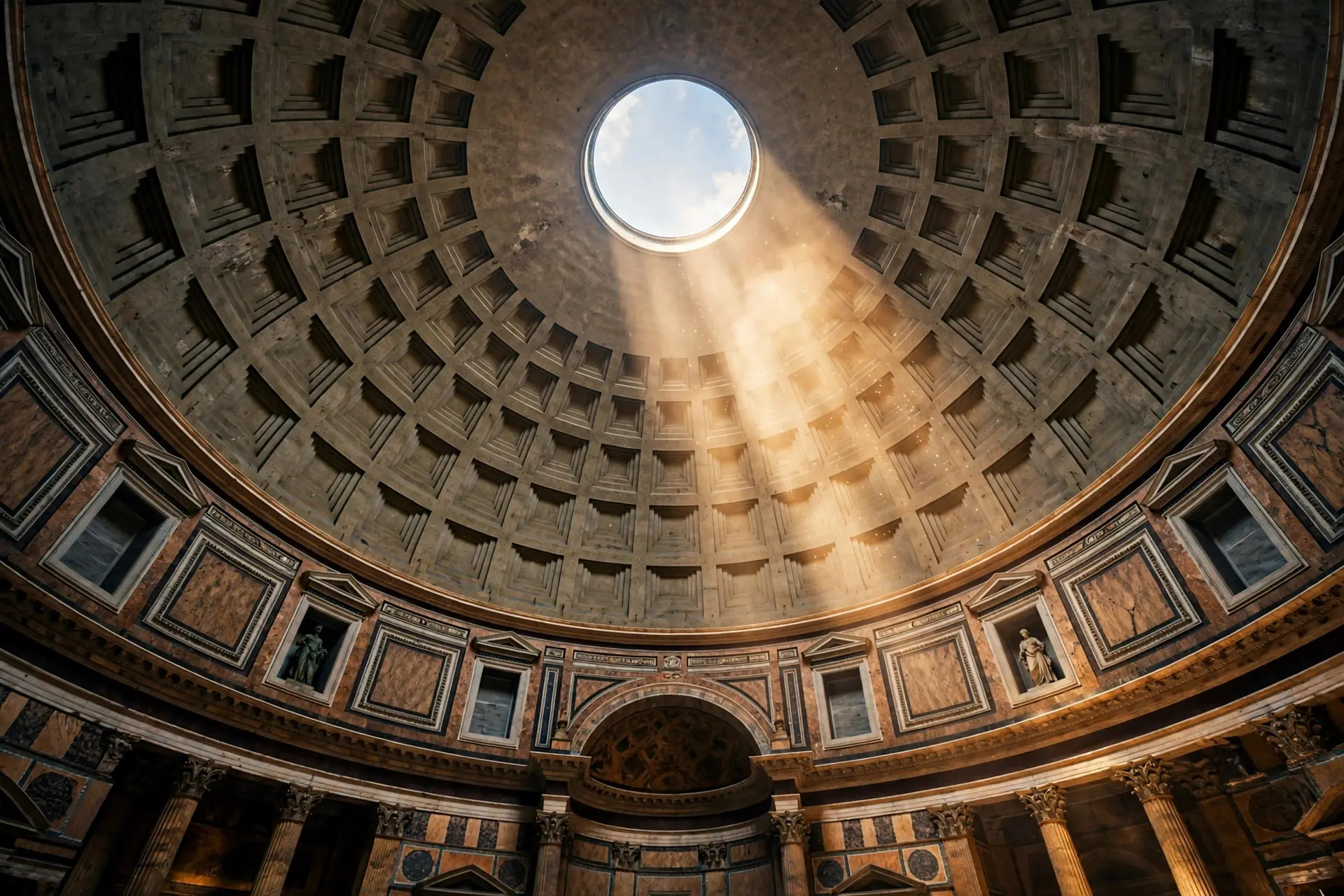
- Rome's Pantheon carries the world's largest unreinforced concrete dome; dedicated in 128 CE, it still stands intact after nearly 1,900 years. (MIT News)
- On January 6, 2023, a team led by MIT civil engineering professor Admir Masic published the hot-mixing explanation in the journal Science Advances, based on 2,000-year-old mortar from a city wall at Privernum, Italy. (MIT News)
- Roman builders shipped volcanic ash from Pozzuoli on the Bay of Naples across the empire; for decades scholars assumed this pozzolana was the whole secret of the concrete's durability. (MIT News)
- In the team's lab test, deliberately cracked hot-mixed samples sealed completely within two weeks and stopped leaking, while an identical mix made without quicklime never healed. (MIT News)
- In December 2025 the same MIT group confirmed the recipe at a construction yard in Pompeii, preserved by the 79 CE eruption of Vesuvius, where piles of dry pre-mixed quicklime and ash survived untouched. (MIT News)
- Cement production accounts for about 8 percent of global greenhouse gas emissions, which is why a Roman self-repair trick matters far beyond archaeology. (MIT News)
What are lime clasts, and why did researchers dismiss them?
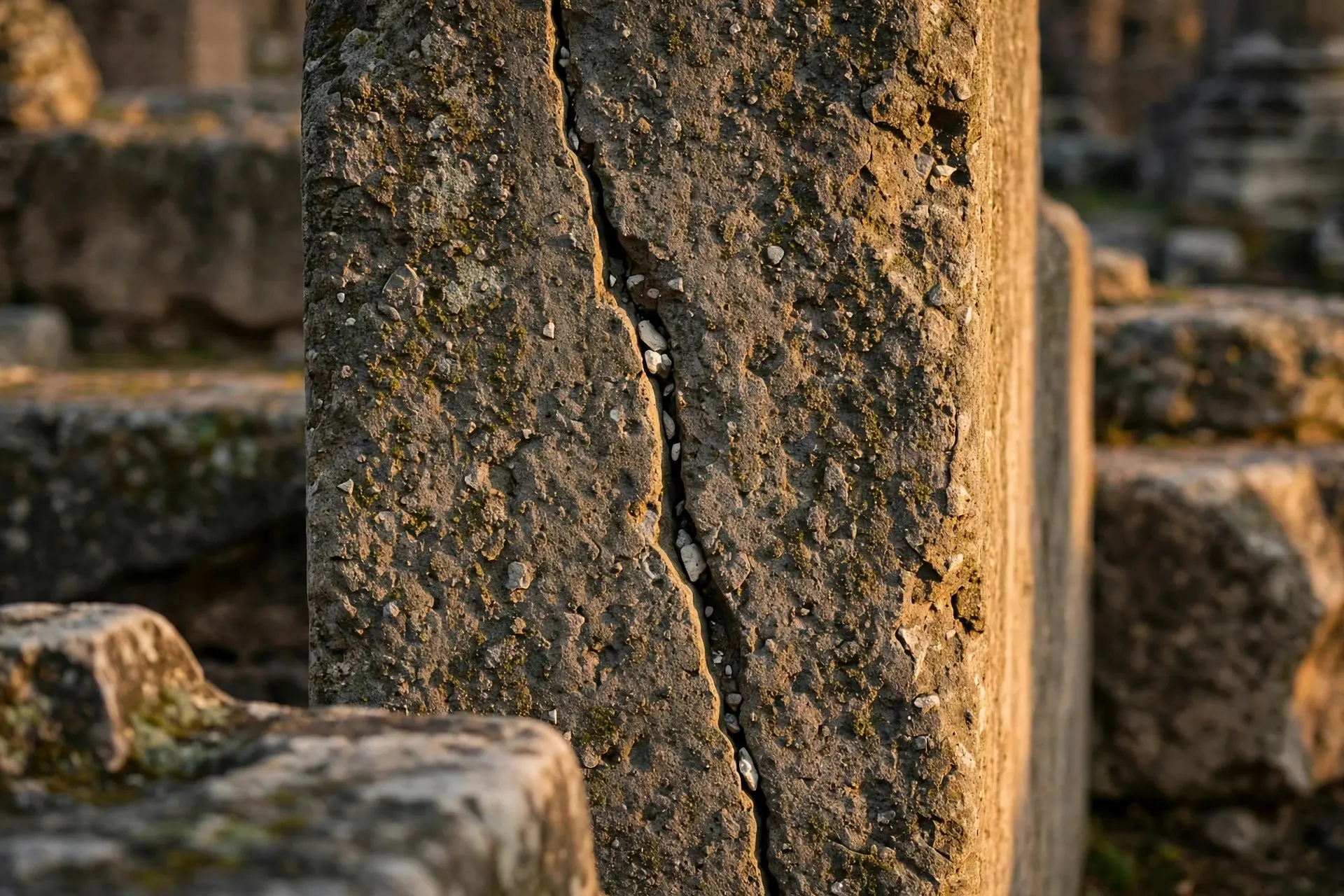
Look closely at broken Roman mortar and you will see them: millimeter-scale bright white flecks scattered through the gray matrix. These lime clasts are one of the most common features of ancient Roman concrete, and for generations researchers read them as a flaw, leftover lime that never mixed in properly, evidence of sloppy workmanship or poor raw materials. That reading always troubled Admir Masic. As he told MIT News, the Romans had spent centuries optimizing their concrete recipes, so the idea that master builders were simply careless about mixing never sat right. His team at MIT, working with colleagues from Harvard University and laboratories in Italy and Switzerland, decided to examine the clasts instead of ignoring them. What they found overturned the old story: the white inclusions were not unmixed mistakes. They were made of various forms of calcium carbonate carrying the chemical signature of formation at extreme temperatures, the fingerprint of quicklime used hot. As Masic put it, "There has to be more to this story."
How does hot mixing give concrete a self-repairing chemistry?
The traditional assumption was that Roman lime always entered the mix slaked: first combined with water into a reactive paste, then blended with volcanic ash and aggregate. Masic's team proposed something different. The Romans, they argued, sometimes mixed quicklime (calcium oxide) directly with volcanic ash and other dry ingredients, adding water last, so the slaking reaction fired inside the batch and released intense heat. This "hot mixing" had two advantages. First, the high temperatures enabled chemistries that slaked lime alone could not produce, forming high-temperature compounds in the mortar. Second, the heat accelerated every reaction, cutting curing and setting times and allowing much faster construction. The heat also froze the process partway: pockets of lime never fully slaked, surviving as brittle, nanoparticle-rich clasts with enormous reactive surface area. That is where the self-repair comes in. When a tiny crack opens, it preferentially travels through one of these fragile clasts. Water seeping into the crack dissolves calcium from the clast, creating a calcium-saturated solution that recrystallizes as solid calcium carbonate, or reacts with nearby pozzolanic material to strengthen the matrix further. The crack fills itself, spontaneously, before it can spread. To prove it, the team cast Roman-inspired concrete with and without quicklime, cracked both deliberately, and ran water through the gaps. Within two weeks the hot-mixed cracks had healed shut and the water stopped; the quicklime-free control kept leaking indefinitely.
What did the Pompeii construction site prove in 2025?
The 2023 finding had one awkward problem: it contradicted Vitruvius. The Roman architect's De architectura, written in the 1st century BCE, describes lime being slaked into a paste before mixing, with no mention of hot mixing. Then archaeologists uncovered an active Roman construction yard at Pompeii, flash-preserved by the eruption of Vesuvius in 79 CE, complete with raw material piles and tools. Masic's team sampled the dry pre-mixed piles, a half-built wall, finished buttresses, and mortar repairs in an older wall. In the dry piles they found intact quicklime fragments already blended with volcanic ash: the exact first step hot mixing requires. Stable-isotope analysis let them trace the carbonation reactions over time and distinguish hot-mixed lime from Vitruvius-style slaked lime. The ash held another surprise. Pumice particles in it had reacted with the surrounding pore solution over the centuries, growing new mineral deposits that strengthened the concrete still further. The results, published in Nature Communications in December 2025, confirmed that hot mixing was genuine Roman practice rather than a laboratory artifact. Masic, who wept on first walking the preserved work yard, suggested Vitruvius may simply have been misread: the old text does mention latent heat during the mixing process.
What do people get wrong about self-healing concrete?
The phrase "self-healing" invites magical thinking, so three corrections matter. First, nothing alive is happening. The repair is plain chemistry: water dissolves calcium, and calcium carbonate recrystallizes, the same process that builds stalactites in caves. Without water reaching the clasts, no healing occurs. Second, nobody has watched a 2,000-year-old wall heal in real time. The two-week healing was demonstrated on modern Roman-inspired samples in a laboratory; what the ancient structures show is consistent evidence, including old cracks found already filled with calcite. Third, lime clasts are not the entire explanation. Volcanic ash, careful aggregate grading, massive wall thicknesses, and structural design all contributed to Roman durability. The clasts are a previously unrecognized piece of the puzzle, not the only piece.
| Test | Hot-mixed sample (with quicklime) | Control sample (no quicklime) |
|---|---|---|
| Lime clasts in the mix | Present | Absent |
| Crack after two weeks of water flow | Completely healed | Still open |
| Water leakage | Stopped | Continued |
| The MIT team's 2023 crack test, summarized from MIT News. | ||
| The white lumps were not a defect but the medicine: a built-in repair kit that activates whenever water finds a crack. Roman engineers even poured this concrete underwater for harbor works that still stand in seawater, and their aqueduct network still carries water to Rome in places. Whether modern cement makers can translate the trick into longer-lived concrete, and cut into that 8 percent of global emissions, is the question Masic's team is now pursuing. The Pantheon's unreinforced dome has already run the experiment for 1,900 years. | ||
| How we made this article: FactSpire researched and drafted it with AI assistance and checked every fact against the sources listed above. |
Frequently asked questions
Did the Romans know their concrete could self-heal?
There is no evidence they understood the chemistry. They followed recipes refined over centuries because the results lasted, and the mechanism stayed hidden until the MIT team decoded it in 2023. The builders knew what worked; they did not know why it worked.
Can modern concrete be made to self-heal the same way?
That is the goal. Masic's team is working to commercialize modified cement based on the Roman recipe, aiming for longer service life and more durable 3D-printed concrete. With cement production causing about 8 percent of global greenhouse gas emissions, longer-lived concrete would also cut climate impact.
Does every Roman building heal its own cracks?
No. The chemistry needs water to reach the lime clasts, and the two-week healing was demonstrated on modern Roman-inspired samples in a lab, not on ancient walls. Old Roman structures do show calcite-filled cracks consistent with the mechanism, but it is one factor among several.
What exactly is hot mixing?
It means mixing quicklime with volcanic ash and other dry ingredients before adding water, so the slaking reaction fires inside the batch and releases intense heat. The heat creates compounds that slaked lime alone cannot produce and leaves reactive lime clasts trapped in the hardened concrete.
Sources
- Riddle solved: Why was Roman concrete so durable?, MIT News
- Pompeii offers insights into ancient Roman building technology, MIT News
- Researchers dig up secrets of 'self-healing' Roman concrete, Phys.org
- A Preserved Construction Yard In Pompeii Reveals A Missing Step In Making Roman Concrete, IFLScience