What Is Africa's Deepest Lake? Inside Lake Tanganyika
What is the deepest lake in Africa? Lake Tanganyika plunges 1,470 m (4,823 ft): the world's longest freshwater lake and second-deepest lake, after Baikal.
Key takeaways
- Lake Tanganyika, at 1,470 m (4,823 ft), is the deepest lake in Africa and the second-deepest in the world after Lake Baikal.
- At 673 km (418 miles) it is the longest freshwater lake in the world, shared by Burundi, the DRC, Tanzania and Zambia.
- Its roughly 18,900 km³ of water is the largest freshwater volume in Africa, nearly as much as all five North American Great Lakes.
- The central basin began forming 9–12 million years ago in the western branch of the East African Rift, making it Africa's oldest lake.
- A 2019 University of Basel inventory lists 208 valid cichlid species in the lake, all but two of them endemic.
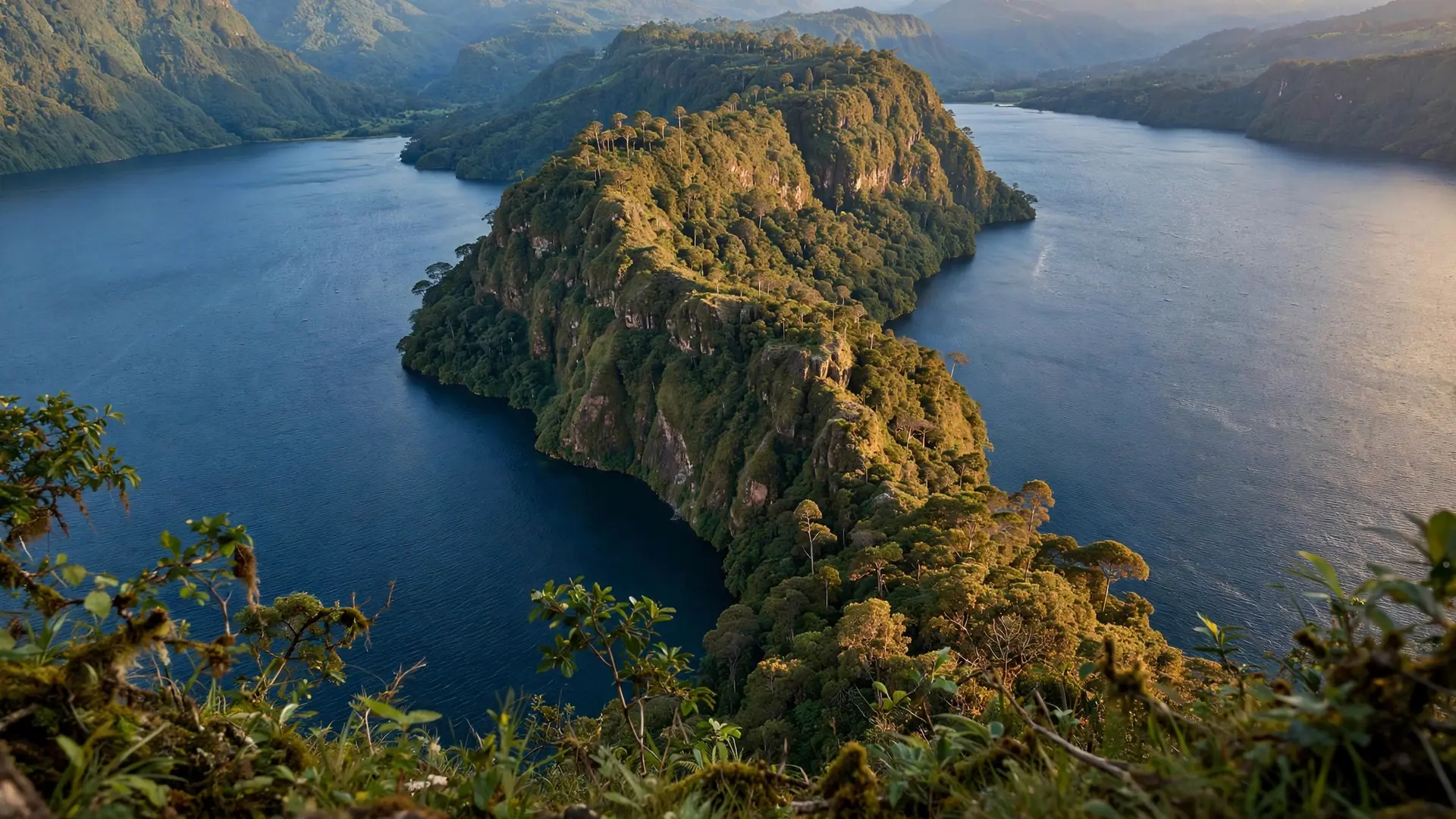
Lake Tanganyika, at 1,470 m (4,823 ft), is the deepest lake in Africa. Its floor lies about 700 m below sea level, and the lake holds almost as much water as all five North American Great Lakes combined. Stretching 673 km across four countries, this rift lake is also the longest freshwater lake on Earth.
What is the deepest lake in Africa?
The answer is Lake Tanganyika. It runs north to south through east-central Africa along the western branch of the East African Rift, sitting at 773 m (2,536 ft) above sea level between latitudes 3°20' and 8°48' S. Only Lake Baikal, the world's deepest lake, plunges deeper anywhere on Earth.
- A maximum depth of 1,470 m (4,823 ft), confirmed by a UN Food and Agriculture Organization survey in March 1993: the deepest point of any lake in Africa and the second-deepest in the world.
- A length of 673 km (418 miles), making it the longest freshwater lake in the world, measured north to south from 3°20' to 8°48' S.
- A volume of about 18,900 km³: the greatest freshwater volume on the African continent and, behind only Baikal, the second-largest of any freshwater lake.
- Four shoreline countries: Burundi, the Democratic Republic of the Congo, Tanzania and Zambia, with the DRC and Tanzania holding the largest shares.
- An age of 9–12 million years for the central basin, established by Cohen, Soreghan and Scholz in the journal Geology in June 1993, making it the oldest lake in Africa.
- 208 formally described cichlid species, with at least 241 estimated and all but two found nowhere else on Earth, per a 2019 University of Basel inventory. By surface area the lake covers 32,900 km² (12,700 sq mi), which makes it only the second-largest of the African Great Lakes, since Lake Victoria spans 26,828 sq mi. Lake Superior remains the largest freshwater lake by surface area in the world, and the second-largest lake of any kind if the brackish Caspian Sea is counted (WorldAtlas, 2026). But on depth and volume, Tanganyika has no African rival.
How did a rift valley carve the world's second-deepest lake?
Tanganyika exists because Africa is slowly splitting apart. The lake sits in the western branch of the East African Rift, where the African and Somali plates are pulling away from each other. That stretching thins the continental crust, which drops down along faults and forms deep, steep-sided basins. The Great Rift Valley is the larger system of which this western branch is a part, and Tanganyika is its deepest expression. The 1993 study by Cohen, Soreghan and Scholz dated the basin formation with reflection-seismic data and radiocarbon-dated sediment cores. Their method suggested the central basin began opening 9–12 million years ago, the northern basin 7–8 million years ago, and the southern basin 2–4 million years ago. The estimates were considerably younger than most earlier guesses, which had stretched the lake's age toward 20 million years. The rift walls still tower over the water. Along parts of the western shore, escarpments rise as much as 2,000 m (6,562 ft) above the shoreline. Over millions of years the lake level itself has swung dramatically, dropping by as much as 500 m at times. Those swings split and reconnected fish populations and helped drive the lake's famous burst of new species.
How do we know it is 1,470 metres deep?
The figure comes from serious, old-fashioned fieldwork. The FAO's Lake Tanganyika Research project, fully operational from January 1992, carried out an aerial frame survey of the whole lake between September 29 and October 3, 1992, flying a small plane along the entire shoreline and recording it on video. The survey measured the shoreline at 1,838 km, 22.5% longer than previously published, and recorded the lake's physical profile: 673 km long, a maximum width of 48 km, an average depth of 570 m, a maximum depth of 1,470 m, and a volume of about 18,800 km³. Independent sources have converged on the same numbers ever since. The habitats data compiled by cichlid researchers lists 1,470 m, 570 m average depth and about 18,900 km³. WorldAtlas, in a September 2026 survey of the lake's records, reports the same depth and calls Tanganyika "Africa's deepest lake and the world's second-deepest freshwater lake after Lake Baikal." Tanganyika is also remarkably clear: visibility exceeds 20 m in open water. In the coldest month, August, surface water sits near 24°C (75°F); in the warmest month, February, it reaches about 27°C (81°F). Because the lake sits almost on the equator, between 3°20' and 8°48' S, there are no cold winters to drive the seasonal turnover that mixes temperate lakes. Its deep water sits undisturbed.
What most people get wrong about Lake Tanganyika
"Lake Victoria is Africa's biggest and deepest lake." Victoria wins on surface area, but Tanganyika holds the continent's greatest freshwater volume and is by far its deepest. Size has more than one dimension, and Victoria is the shallow giant to Tanganyika's deep one.
"Its age is settled science." The 9–12 million year figure is the best seismic-based estimate, published in 1993, but earlier estimates ran much higher, and the different basins formed at different times. The northern and southern basins are millions of years younger than the central one. "Oldest lake in Africa" is safe; a single precise birthday is not. "The whole lake teems with life." Oxygen exists only in the upper layers: down to roughly 240 m in the south and just 100 m in the north. Below that boundary the water is anoxic "fossil water" with no oxygen and no life. Most of the lake's enormous volume is a dark, lifeless column of ancient water. "It is one country's lake." Four nations share it: Burundi, the Democratic Republic of the Congo, Tanzania and Zambia. The FAO's 1993 report records the Congolese share under the country's then-name, Zaïre. Tanganyika is a transboundary waterway, not a national one.
How deep is 1,470 metres, really?
Numbers that big need a scale. Here is what the lake's depth means, calculated from the survey figures:
- 4,823 ft. Multiply 1,470 m by 3.28084 and you get 4,822.8 ft, conventionally rounded to 4,823 ft. In imperial terms the lake's deepest point lies nearly a mile straight down.
- About 697 m below sea level. The FAO puts the lake's surface at 773 m above sea level, so subtract: 1,470 − 773 = 697 m. The bottom of the lake sits well beneath the level of the ocean.
- Roughly 6.6 times Kalambo Falls. Near the lake's southeastern end, the Kalambo River plunges 221 m (725 ft) at Kalambo Falls before reaching the lake. Tanganyika at its deepest is about 6.6 times that height, stacked vertically.
- About 3,470 m of total relief. Add the up-to-2,000 m escarpments towering above the western shore to the 1,470 m of water below the surface. From rift wall to lake floor, the system spans roughly 3,470 m.
- 5,500 years to flush. The lake's estimated water retention time means a drop entering today would, on average, leave around the year 7526. That near-stagnation is why the deep water has sat anoxic for so long. For comparison, the Mariana Trench, the deepest point in the ocean, reaches nearly 11,000 m, a different scale of extreme entirely. Among freshwater lakes, though, only Baikal goes deeper. And Tanganyika is not even close to the highest: that distinction belongs to Lake Titicaca, the world's highest navigable lake, perched in the Andes. Tanganyika's superlatives rest on solid, repeated measurement: Africa's deepest lake, the world's second-deepest, the longest freshwater lake, the continent's largest freshwater volume, and its oldest lake. Twelve million years of rifting built a basin so deep its floor sits below sea level, and the basin is stable enough that evolution had time to fill it with hundreds of fish found nowhere else on Earth. How we made this article: FactSpire researched and drafted it with AI assistance and checked every fact against the sources listed above.
Frequently asked questions
Is Lake Tanganyika the deepest lake in the world?
No. Tanganyika is the second-deepest freshwater lake on Earth after Lake Baikal in Siberia, Russia. At 1,470 m (4,823 ft), it is the deepest lake in Africa. Both rankings are confirmed by the UN Food and Agriculture Organization's 1993 survey of the lake.
Which countries share Lake Tanganyika?
Four: Burundi, the Democratic Republic of the Congo, Tanzania and Zambia. The FAO's 1993 survey records the DRC's share under its then-name, Zaïre. The lake stretches 673 km (418 miles) north to south across all four borders, between 3°20' and 8°48' S latitude.
Why is Lake Tanganyika so deep?
It sits in the western branch of the East African Rift, where the African and Somali plates are pulling apart. That stretching of continental crust created steep fault-bounded basins. Along parts of the western shore, rift escarpments rise as much as 2,000 m (6,562 ft) above the water.
Can anything live in the deepest parts of Lake Tanganyika?
No. Oxygen exists only in the upper layers, down to about 240 m in the south and 100 m in the north, so the deep water is anoxic and lifeless. Fish and most oxygen-dependent animals stay near the surface; below them lies ancient 'fossil water' with no life at all.
Sources
- Aerial Frame Survey of Lake Tanganyika Fisheries, Food and Agriculture Organization of the United Nations
- Lake Tanganyika Habitats, Tanganyika.si
- Estimating the age of formation of lakes: An example from Lake Tanganyika, East African Rift system, U.S. Department of Energy Office of Scientific and Technical Information
- The taxonomic diversity of the cichlid fish fauna of ancient Lake Tanganyika, East Africa, National Library of Medicine (PMC)
- How Lake Tanganyika Holds Almost As Much Water As All Five Great Lakes, WorldAtlas