The Discovery of Oil and the Petroleum Age
In 1859 a retired railroad conductor struck oil at 69 feet in Pennsylvania. How petroleum went from lamp fuel to the fuel that powers the modern world.
Key takeaways
- On August 27, 1859, Edwin Drake struck oil at about 69 feet near Titusville, Pennsylvania — the first well drilled specifically to find oil in commercial quantity.
- Drake's real innovation was technique: he adapted salt-well drilling and drove iron pipe downhole to keep the borehole open.
- The boom was instant: the region went from 4,500 barrels in 1859 to 3 million barrels by 1862, and Standard Oil soon controlled most US refining.
- Kerosene was the first great oil product; gasoline was nearly worthless until the internal combustion engine and the Model T gave it a purpose.
The modern world runs on oil because, in 1859, a former railroad conductor with no geological training and a self-awarded military title proved that petroleum could be pumped from the ground in industrial quantities. Edwin Drake's well in Pennsylvania was only 69 feet deep, but it drilled a hole straight into the petroleum age — an era in which the world now burns through roughly 100 million barrels of oil every single day.
What oil is and where it came from
Petroleum is the decomposed remains of ancient marine life — plankton and algae that settled onto seafloors millions of years ago, were buried under sediment, and were slowly cooked by the Earth's heat and pressure into a dense, energy-rich liquid. Because it is lighter than water and under enormous underground pressure, it sometimes migrates upward and seeps out at the surface. Those seeps were humanity's first encounter with oil, thousands of years before anyone drilled a well. Ancient builders caulked ships and bricks with bitumen, the tarry residue of seeps. In western Pennsylvania, settlers found dark pools of it along Oil Creek, where locals skimmed about 18 gallons a day from the surface to lubricate sawmills. At first oil was even sold as a curative potion, a kind of medicine-show remedy. Then Pittsburgh tinsmith Samuel Kier found a better use: a simple cast-iron still that refined crude oil into kerosene, a clean-burning fuel for lamps. Kerosene touched off the search for a dependable supply of crude — and the search led to drilling.
The colonel who drilled for gold that was black
Edwin Laurentine Drake arrived in Titusville, Pennsylvania, in the late 1850s as an agent of Connecticut's Seneca Oil Company, tasked with finding oil in quantities that could feed the growing kerosene business. He was not, despite the title everyone used, a colonel in any army. He had taken to calling himself "Colonel Drake" because he thought it lent him authority with investors — an honest con that the locals quietly mocked, calling his project "Drake's Folly."
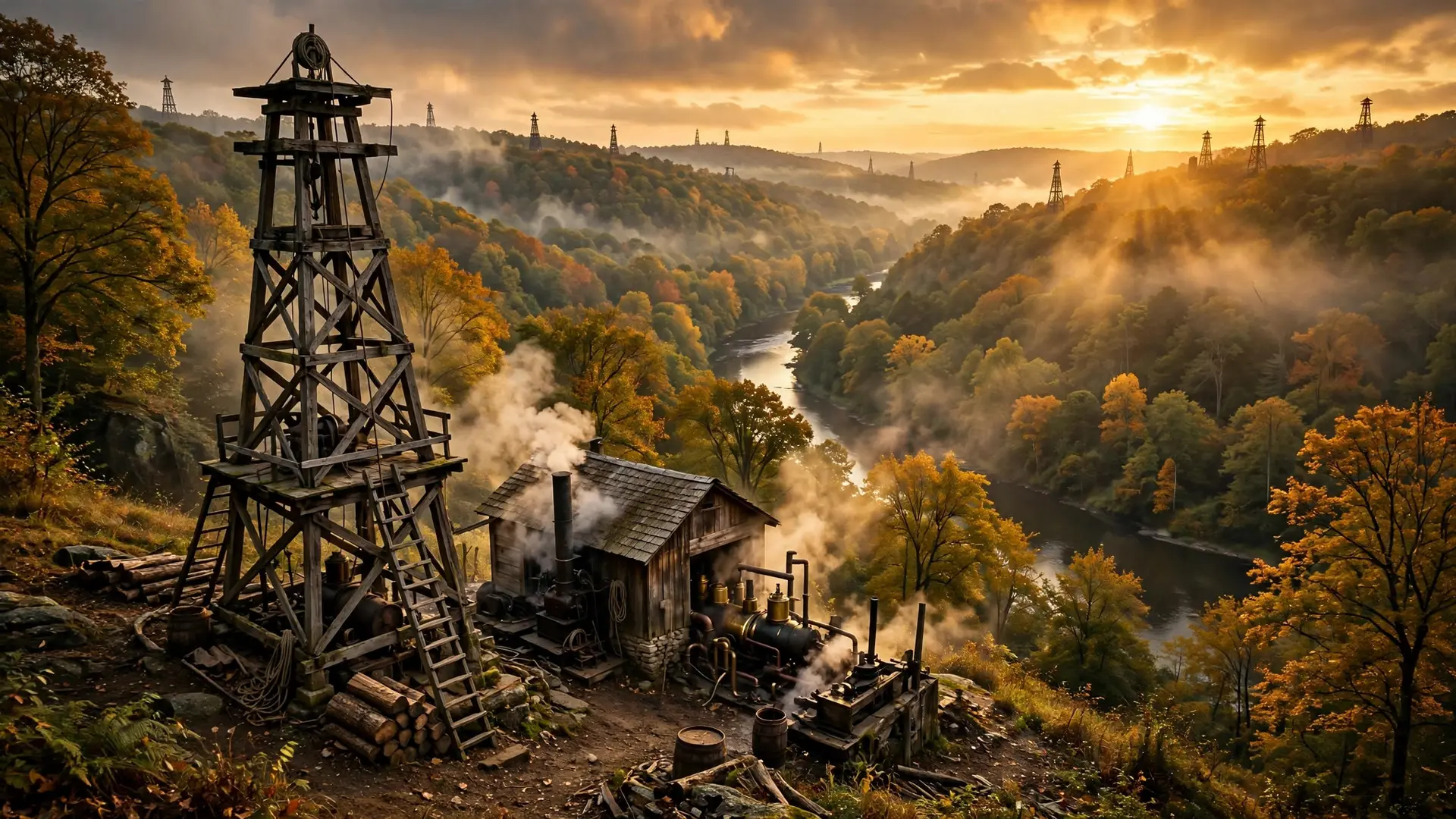
Drake's key insight was not geological; it was mechanical. He borrowed techniques from salt-well drilling and worked with a local blacksmith, William "Uncle Billy" Smith, to punch through the loose gravel near the creek bed. His signature innovation was driving iron pipe down through the loose soil to the bedrock, protecting the borehole from collapsing — a method so practical it is still part of drilling today. He powered the drill with an old steam engine. On August 27, 1859, at a depth of about 69 feet, the drill hit oil. The well began yielding roughly 1,000 gallons a day and kept producing for years. It was the first well in the United States drilled specifically to find oil, and the first to produce it in commercial quantity. The locals who had laughed at Drake's folly watched derricks sprout across the hillsides within months.
The boom, the monopoly, and the man left behind
The effect was electric. By the end of 1859, the Oil Creek region had produced 4,500 barrels. The next year it produced several hundred thousand, and by 1862 output had reached 3 million barrels. Fortunes were made and lost in a froth of speculation that recalled earlier manias like the Dutch tulip bubble: everyone wanted a piece of the black gold. Out of the chaos stepped John D. Rockefeller. Rather than gamble on drilling, Rockefeller bet on refining — and won. His Standard Oil Company, founded in Cleveland in 1870, absorbed rivals, negotiated hard railroad deals, and drove costs relentlessly down. By the 1880s Standard Oil controlled more than nine-tenths of American oil refining, turning chaotic kerosene into a cheap, reliable household fuel. Investigative journalist Ida Tarbell exposed its ruthless tactics in her 1904 book, and in 1911 the US Supreme Court broke the trust into 34 independent companies — the ancestors of today's ExxonMobil, Chevron, and others. Kerosene had made oil an industry; Rockefeller had made it an empire. The strangest figure in this story is Drake himself. He did not own the land he drilled on, he never patented his pipe-driving method, and Seneca Oil let him go in 1860 for a token payment. He spent his last years speculating on Wall Street and died a poor pensioner in 1880, three decades before the industry he created honored him with a museum and a monument at the well site. Pennsylvania finally granted him an annuity in 1876 — a meager, belated thanks for the petroleum age.
From lamp fuel to gasoline: oil's second act
Drake's oil was refined mainly into kerosene, but the refinery also produced a volatile, flammable fraction that nobody wanted: gasoline. Before the internal combustion engine, gasoline had so little use that refineries sometimes just dumped it. The kerosene age was, by accident, building up stockpiles of the fuel that would define the next century. The pivot arrived with the automobile. The internal combustion engine gave gasoline a purpose, and Henry Ford's Model T, introduced in 1908, made cars affordable to millions — creating a vast new demand for a fuel that had once been waste. Oil's center of gravity shifted from the lamp to the engine, and the hunt for crude spread worldwide. The same year the Model T debuted, George Reynolds's drilling team struck oil at Masjed Soleyman in Persia, at 360 meters deep, after seven years of searching under William Knox D'Arcy's concession. That discovery founded the Anglo-Persian Oil Company — the ancestor of BP — and began the Middle East's rise as the industry's great reservoir.
The misconception: Drake was not the first — but that hardly matters
Strictly speaking, Drake's well was not the first to find oil. A drinking-water well at Oil Springs, Ontario, had struck oil a year earlier, in 1858, and other regions — Azerbaijan, Poland, Persia — have their own claims. What Drake did was different in kind: he drilled for oil on purpose, with the right technique, in front of investors, and then his success drew a wave of imitators. As historians put it, the Drake Well's importance was not in being first but in being imitated — it created, almost overnight, a supply of petroleum large enough to support real businesses, and the investment flooded in behind it. Today oil fuels roughly three-fifths of global transport, fires power stations, and feeds the petrochemical plants that make everything from fertilizer to plastics — though the energy transition is gathering pace, from lithium-ion batteries to solar panels that turn sunlight into power. It is a direct lineage from a 69-foot hole in a Pennsylvania creek bed. A century and a half of progress began the day a fake colonel's drill bit dropped into the dark and struck liquid history.
Frequently asked questions
Who discovered oil?
No one discovered oil — it has seeped from the ground for millennia. Edwin Drake made the first successful commercial discovery in 1859 by drilling for it deliberately near Titusville, Pennsylvania.
Why was the Drake Well important if it was not the first?
Earlier wells found oil by accident or produced small amounts. Drake's well proved oil could be obtained in industrial quantity, triggering the first great wave of drilling, refining, and investment.
What was the first oil company?
Drake drilled as an agent of the Seneca Oil Company. John D. Rockefeller's Standard Oil, founded in 1870, then became the first great oil monopoly, refining over nine-tenths of US oil by the 1880s.