How the Panama Canal Finally Conquered the Jungle
Ships crossing Panama climb 85 feet over a jungle ridge via locks, a man-made lake, and a mountain cut. Here is how engineering beat a doomed French dream.
Key takeaways
- The French sea-level plan failed by 1889 after about 20,000 deaths from disease and a bankruptcy that wiped out 800,000 investors.
- The American design lifts ships 85 feet over the isthmus with three lock systems fed by Gatun Lake, an artificial lake created by damming the Chagres River.
- The Culebra Cut carved a 12.6-kilometre trench through the Continental Divide, dug largely by steam shovels and a massive rail system.
- Colonel William Gorgas beat yellow fever and malaria by draining swamps, oiling standing water, and screening homes, saving tens of thousands of lives.
- The canal opened on August 15, 1914, with the transit of the SS Ancon; a single ship transit still uses about 52 million gallons of fresh water.
The Panama Canal should not exist. A French company spent eight years and the equivalent of a billion francs trying to dig a flat ditch across the Panamanian jungle, and the jungle won: disease emptied the work camps, the mountains swallowed the digging, and the company collapsed in 1889 with 800,000 small French investors ruined. Yet twenty-five years later, ships were gliding 85 feet above the sea through a lake that humans built inside a jungle. The difference was not money or manpower. It was a humbler engineering idea: stop fighting the landscape, and lift the ships over it instead. That pivot — from de Lesseps's sea-level fantasy to a staircase of water — is the story of how the canal was actually built.
Why did the French effort fail so completely?
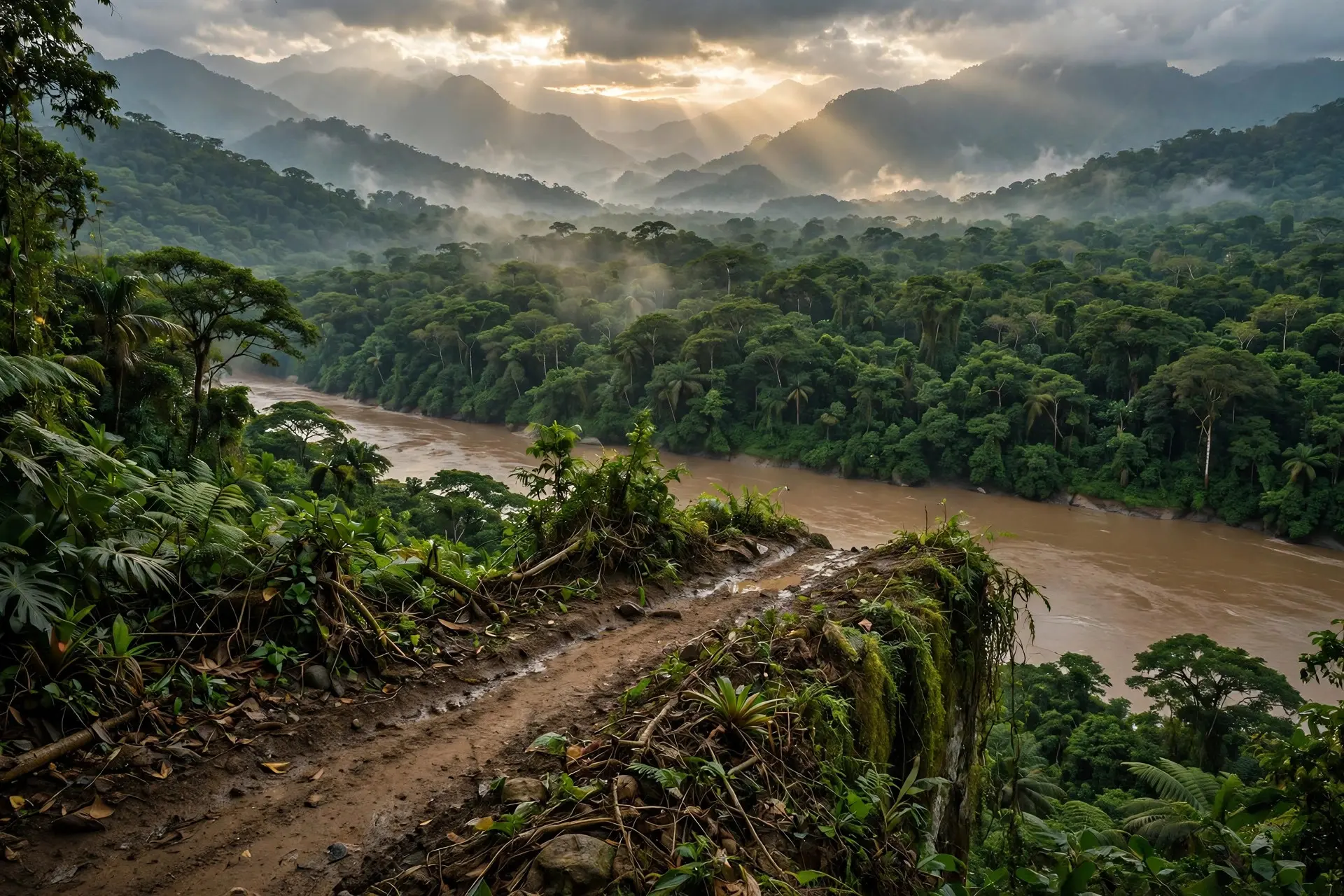
The French arrived with the most famous resume on earth. Ferdinand de Lesseps, the diplomat who had led the construction of the Suez Canal, began excavating at Panama in 1881 convinced that the same formula would work twice. But Suez was a flat desert trench; Panama was a mountainous rainforest that receives nearly ten feet of rain a year, with soils that slide downhill the moment you dig into them. De Lesseps had visited Panama during the three-month dry season and planned for that weather. During the other nine months, rain triggered mudslides that buried workers alive, flooded the excavation, and made the already brutal job of cutting through the Culebra ridge nearly impossible. Worse, nobody yet understood that mosquitoes carried yellow fever and malaria, so French hospitals — with bed legs standing in pans of water to keep out ants — bred the very insects that were killing the patients. A Canadian doctor estimated that between 30 and 40 workers a day died during the wet seasons of 1882 and 1883, and three-quarters of the French engineers who arrived died within three months. By the time the company abandoned the project in 1889, accidents and disease had claimed roughly 20,000 laborers, most of them workers from Caribbean islands such as Jamaica, Barbados, and Antigua. The collapse detonated the Panama Scandal in France, with bribed legislators and the prosecution of de Lesseps himself, who died a ruined man in 1894. The opium-wars-trade-empire article shows how badly the 19th century's great powers misread tropical terrain — Panama was the same lesson, taught at a far higher price.
What changed when the Americans took over?
Everything started with disease. When the United States bought the French assets in 1904 for $40 million — the concession, the Panama Railway, some 2,000 buildings, and the abandoned machinery — chief engineers John Stevens and George Goethals inherited the same jungle and the same mosquitoes. Colonel William Gorgas, the Army surgeon who had helped eradicate yellow fever in Cuba, refused to let construction scale up until sanitation came first. Gorgas waged war on standing water: swamps were drained, ditches filled, and inspectors visited every home in Colón to make sure wells, cisterns, and water jars were covered and outdoor puddles were coated with oil or kerosene. Within a few years, yellow fever was essentially gone from the work zone and malaria deaths collapsed. Gorgas is credited with saving tens of thousands of lives — and no version of the canal could have been built without his campaign first. Stevens also made the decisive engineering call. Where de Lesseps had demanded a sea-level channel, the Americans would build a lock canal: raise ships up to a mountain lake and lower them again, accepting the cost of giant lock machinery in exchange for escaping the impossible cut through the divide. It was an admission that the terrain was stronger than the dredgers — and the project never looked back.
How do the locks lift a ship 85 feet?
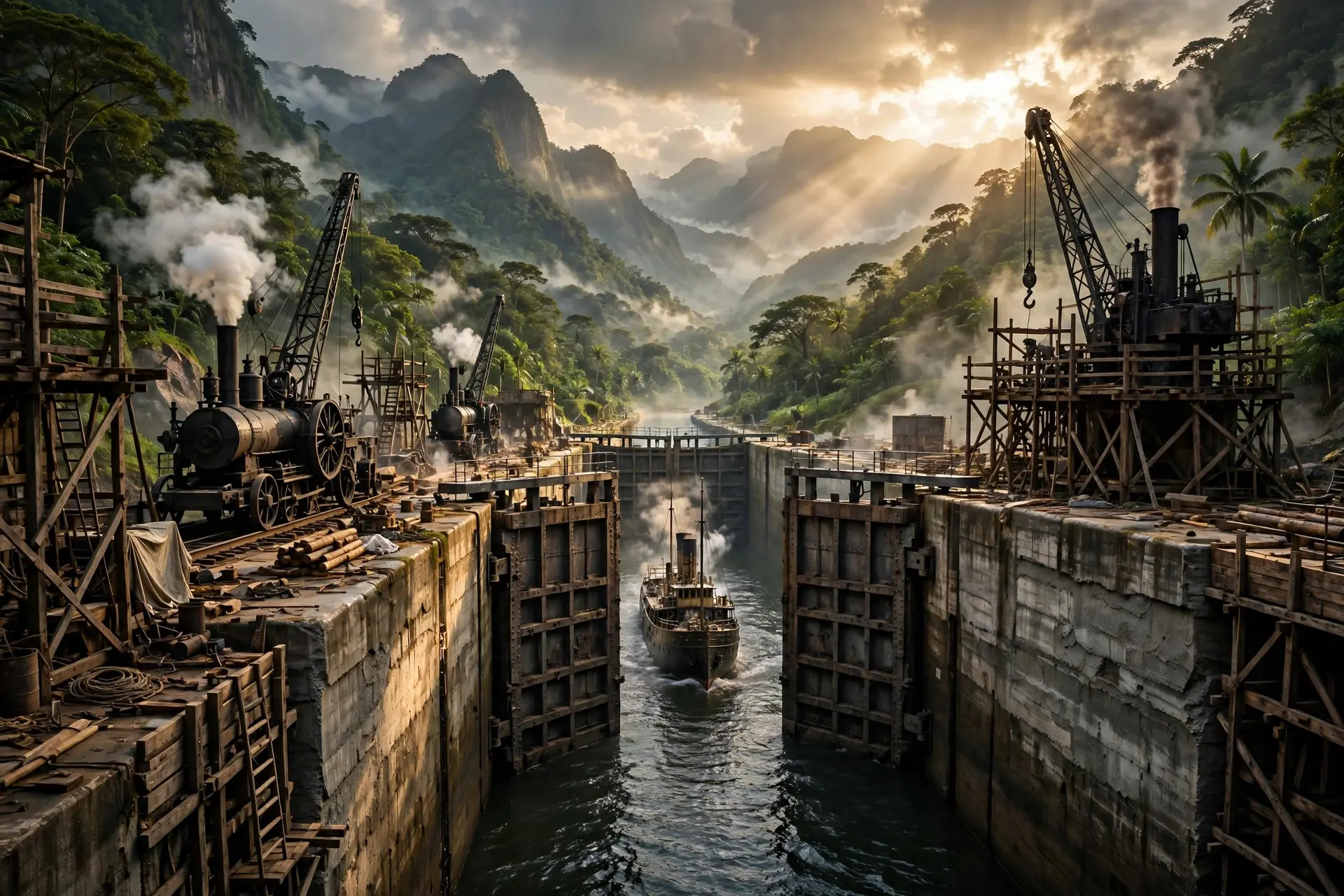
The numbers are hard to picture until you stand inside one of the chambers. The three lock systems — Gatun on the Atlantic side, and Pedro Miguel and Miraflores on the Pacific side — each consist of paired chambers 1,000 feet long and 110 feet wide, walls up to 49 feet thick at the base, and steel miter gates averaging 64 feet wide and 66 feet tall. First concrete was poured at Gatun in August 1909, and building the locks consumed more than two million cubic yards of concrete — a volume unmatched in any single structure until Boulder Dam in the 1930s. The system works entirely on gravity. Gatun Lake sits 85 feet above sea level, and its water flows downhill through culverts into each lock chamber, filling it and floating the ship upward in stages: three steps up at Gatun, one at Pedro Miguel, two down at Miraflores. No pumps are needed; the lake itself is the engine. A single transit uses about 52 million gallons of fresh water, which is why the watershed — and droughts — matter as much to the canal's future as its gates.
Building the locks required its own engineering wonders: overhead cableways with 85-foot towers carried six-ton buckets of concrete on steel cables across the Gatun site, and electric railways shuttled stone and cement from the docks to the mixers around the clock. The great-fire-of-london-1666 account shows how a disaster can force a city to rebuild smarter; the locks show the same idea at the scale of a mountain range.
Why carve a lake into a jungle?
Gatun Lake was the boldest shortcut of all. Rather than dig the entire canal trench down to sea level — the labor that had killed the French effort — engineers dammed the Chagres River with one of the largest earth dams ever built and let the valley flood. When the lake filled in 1913, it became the largest artificial lake in the world, covering some 20 miles of the canal's route with water 85 feet deep enough for ships to simply float across. This is why the Culebra Cut, the great trench through the Continental Divide, only needed to go down to lake level instead of sea level — and even that "shorter" cut was a monster. The cut runs 12.6 kilometres from the Pedro Miguel lock to the lake, and American crews removed some 240 million cubic yards of material from it, hauled away by what was then the largest rail operation in the Western Hemisphere, moving roughly 160 trainloads an hour at peak. Even so, the unstable slopes kept sliding back in, and crews fought the "Hell's Gorge" mud for years.
When did the waters finally meet?
On October 10, 1913, President Woodrow Wilson pressed a telegraph key at the White House that detonated the Gamboa Dike, flooding the last dry section of the Culebra Cut and joining the two oceans. Construction had peaked that May, when the first trial tugboat transited the Gatun locks and lake flawlessly. The official opening on August 15, 1914 — the transit of the cargo ship SS Ancon — was deliberately muted, because World War I had just begun in Europe. The final tally: about $375 million spent, ten years of American construction, and somewhere between 25,000 and 30,000 lives lost across the French and American phases combined. It was the most expensive construction project in American history to that point, and it cut the New York–to–San Francisco voyage from 14,000 miles around Cape Horn to under 6,000. Ships on the-silk-roads-lost-cities trade routes once measured journeys in months and caravan seasons; the canal compressed the Atlantic–Pacific crossing into about 11 hours. The canal's lesson is not that nature was conquered but that it was negotiated with. The French died trying to make the jungle behave like a desert. The Americans succeeded by reading the terrain — the river they could dam, the lake that could supply the locks, the mosquitoes they had to kill first — and designing the canal around it. That remains the engineering ethic behind every later expansion, including the 2016 third lane of Neopanamax locks: work with the water, and the water will carry the ships.
Frequently asked questions
Why did the French attempt at the Panama Canal fail?
Ferdinand de Lesseps insisted on a sea-level canal like Suez, but Panama's mountains, relentless rainfall, and landslides made that unworkable. Yellow fever and malaria killed roughly 20,000 workers, and the company went bankrupt in 1889.
How do the Panama Canal locks actually work?
Ships are raised 85 feet to the level of Gatun Lake through a series of lock chambers at Gatun, Pedro Miguel, and Miraflores. Water from the lake flows into each chamber by gravity, lifting the ship in steps, then lowers it again on the other side.
When did the Panama Canal open, and who built it?
The canal opened officially on August 15, 1914, after the United States bought the French assets in 1904 and completed the work under chief engineers John Stevens and George Goethals.
Who owns the Panama Canal today?
Panama has owned and operated the canal since December 31, 1999, through the Panama Canal Authority. A 2016 expansion added wider locks for larger Neopanamax ships.