How Did the Maya Store Rainwater at Tikal?
Tikal had no river, yet it fed tens of thousands through five-month dry seasons. The Maya turned the city into a rain trap of sloped plazas and sand filters.
Key takeaways
- Tikal had no nearby river or lake, so the Maya harvested rainwater instead, channelling runoff from sloped plaster plazas into reservoirs.
- The city's reservoirs could hold more than 900,000 cubic metres of water, enough for tens of thousands of people through a five-month dry season.
- The Palace Dam, over 260 feet long and about 33 feet high, doubled as a causeway and held about 20 million gallons of water.
- Water was filtered through beds of quartz sand hauled in from tens of kilometres away, since that sand does not occur naturally near Tikal.
- The system worked for over a thousand years but could not survive the severe droughts of the 9th century, which helped bring the city down.
Tikal should not have worked. The great Maya city of the Petén lowlands in northern Guatemala had no river and no lake beside it, yet at its height it supported an estimated 60,000 to 80,000 people in the city and its surroundings. The answer to how it did so was written into the city's very floors. The Maya of Tikal turned their whole city into a rain trap: they sloped its plazas and courtyards so that every downpour ran into channels, dams and reservoirs, stored the water through the long dry season, and filtered it through sand carried in from far away. For more than a thousand years, the system held. Then the rains themselves changed, and it did not.
Why did a city with no river need to catch rain?
Tikal's problem was geological. The city stands on limestone high ground in the southern Maya lowlands, where the ground itself works against water storage: rain percolates down through the porous karst rock instead of pooling on the surface. The climate made the problem seasonal. Roughly 90 percent of the year's rain falls in a seven-month wet season, from late June to late January, and the remaining five months are dry. During the dry season, the jungle turns into what researchers describe as a green desert: small ponds dry up, streams shrink, and the water that remains grows murky. Tikal was not alone in this predicament. None of the largest and most powerful Maya cities of the southern lowlands — Tikal and Naranjo in Guatemala, Caracol in Belize, Calakmul in Mexico — was built beside a river or a lake. Yet all of them had to feed tens of thousands of people through the same dry months. The Maya solution was not to find water but to manufacture it: to catch the rain when it fell, in enormous quantities, and to keep it usable for months. The scale of the solution at Tikal is startling. Archaeologists have excavated and tested several of the city's reservoirs, and their capacity is estimated at more than 900,000 cubic metres of water, assuming annual rainfall of about 1,500 millimetres. Put against the needs of the population, that figure makes sense: if each person used 35 litres a day for drinking, washing, cooking and making ceramics, 80,000 people would need about 400,000 cubic metres to last a five-month dry season. Tikal's reservoirs held more than twice that. The city did not merely scrape by. On paper, it had water to spare.
How did the city itself become a catchment?
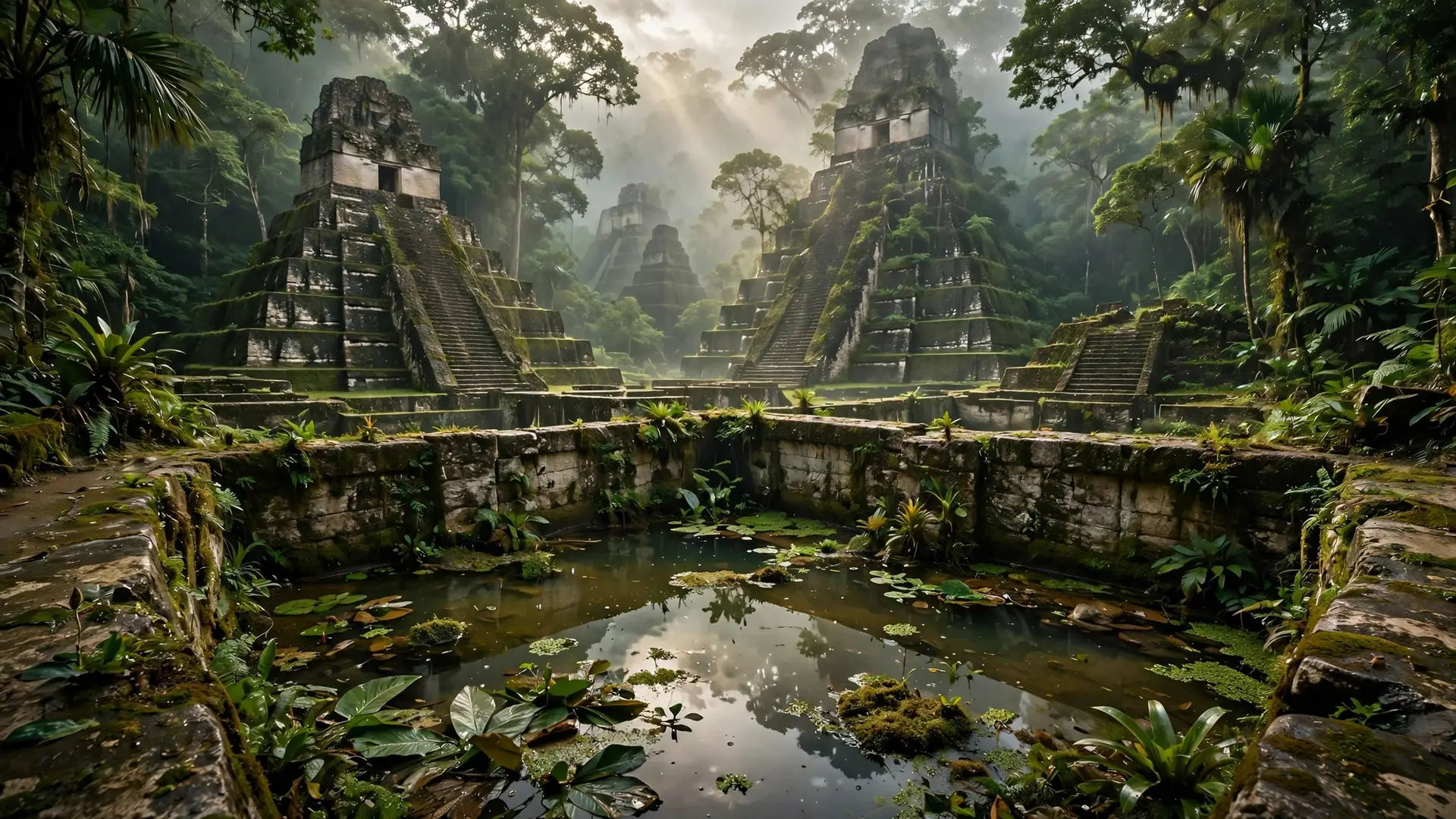
The cleverest part of Tikal's system was that the catchment was the city. The Maya did not build separate waterworks somewhere outside the walls and pipe the water in. They built the waterworks into the urban fabric. The broad plastered surfaces of plazas, courtyards and roadways were deliberately sloped so that rainwater ran off them into canals and then into reservoirs. A visitor walking the Great Plaza in a storm was, without knowing it, standing on a roof. The reservoirs themselves were often dug into existing gullies, the natural drainage lines of the landscape, and then engineered. The Maya sealed them with rammed earth, clay and limestone slabs, fitted them with sluices, spillways, berms and dams to control the flow, and built switching stations that let water be held back or released as the seasons demanded. Some of the reservoirs began life as something else entirely: the great pits first looked to early archaeologists like stone quarries, and they probably were, since quarrying them supplied the limestone for the city's bricks, mortar and plaster. A hole dug for building stone became a tank for water, and the city quite literally built itself out of its own reservoirs. The centrepiece was the Palace Dam, identified by a University of Cincinnati team working at the site core. Built of cut stone, rubble and earth, the dam stretched more than 260 feet in length, stood about 33 feet high, and held about 20 million gallons of water in the reservoir behind it. It is the largest hydraulic structure known in the Maya area, second in size in all of Mesoamerica only to the Purrón Dam in Mexico's Tehuacán Valley, built between about 250 and 400 CE. And it did double duty: the top of the dam served as a roadway linking one part of the city to another, a causeway that tourists still walk today. For a long time it was thought to be only a causeway. The research showed it was a dam as well.
How did they keep the water drinkable?
Storing water is only half the problem. Still water goes bad: nutrients build up, algae bloom, and the water becomes stagnant and undrinkable. The Maya seem to have tackled this with a filter that reveals how much they valued clean water. Where runoff entered the reservoirs, they placed filtration beds of quartz sand — sand that does not occur naturally in the greater Tikal area. They hauled it in from tens of kilometres away, a laborious transport effort for a material whose only job was to strain the water as it flowed in.
Modern research suggests the reservoirs may have done more than store and strain. A 2023 study in the Proceedings of the National Academy of Sciences argues that Maya reservoirs functioned much like today's constructed wetlands: aquatic plants in the water would have taken up nitrogen and phosphorus, limiting algal growth, while decomposing plant matter supported microbial films that broke nutrients down further, and tiny animals preyed on pathogens. The argument rests on excavation evidence, sediment cores and the plant and animal record, and it remains a hypothesis rather than a proven fact — but it fits the pattern of a system designed, from the start, around the quality of the water as well as its quantity. The human side of the system mattered as much as the engineering. During the dry season, people from the surrounding countryside drew closer to the city and its reservoirs, trading labour, craft goods and produce for access to water. Water was not just a resource at Tikal. It was the bargain at the heart of the city's political life: the rulers who controlled the reservoirs controlled the dry season, and the dry season was when the city's power was most visible.
Why did the system eventually fail?
For over a thousand years, the bargain held. Tikal and other centres survived ordinary dry seasons and periodic droughts that forced smaller settlements to be abandoned. The reservoirs were adaptable, repeatedly modified and extended across the centuries, and the system grew more sophisticated as the city grew, reaching its peak in the Late Classic period, roughly 600 to 800 CE. What it could not survive was a change in the climate itself. At least eight severe droughts, each lasting between 3 and 18 years, struck the Maya area between 800 and 930 CE. By then, population and land clearance were at their peak, and deforestation itself may have reduced rainfall by cutting the moisture that trees return to the air. Reservoirs designed to bridge a five-month dry season cannot bridge a drought that lasts a decade. Water supplies dwindled, crops failed, and the social fabric built around water management came under strain it could not bear. The city's population declined, its kings disappeared by about 900 CE, and Tikal was eventually abandoned. There is a temptation to read Tikal's end as a simple story of failure, but that gets the proportions wrong. A rainwater system built with stone tools kept a city of tens of thousands alive in a landscape with no river, through a five-month dry season, for more than a millennium. It failed only when the rains failed for years at a time — a test no reservoir of its size could pass. The lesson of Tikal is not that ancient engineering was fragile. It is that it was remarkably strong, and that even remarkable engineering has a limit, set by the sky. For other ancient answers to the same problem, see how Petra engineered its desert water supply, the qanat tunnels that carried water underground, and the aqueducts that fed Rome.
Frequently asked questions
Why did Tikal need reservoirs?
Tikal was built on limestone high ground in the Petén region of Guatemala, with no river or lake nearby. Rain falls heavily for about seven months but largely stops for five, and much of it drains away through the porous limestone. The Maya therefore had to capture the wet-season rain and store it for the dry months.
How did the Maya collect rainwater at Tikal?
They sloped the city's plastered plazas, courtyards and canals so that rainwater ran off them into a network of channels, dams and reservoirs. The reservoirs were often dug into existing gullies and sealed with clay, rammed earth and limestone slabs, and a switching station let water be released or held back as the seasons changed.
How did the Maya keep reservoir water clean?
They filtered incoming water through beds of quartz sand that had to be hauled in from tens of kilometres away, because quartz sand does not occur naturally around Tikal. Researchers also argue that aquatic plants in the reservoirs acted like a natural constructed wetland, taking up nutrients and supporting microbes that broke them down.
Did Tikal's water system fail?
It worked for over a thousand years and helped the city survive ordinary dry seasons and periodic droughts. But at least eight severe droughts lasting 3 to 18 years struck the Maya area between 800 and 930 CE, and even Tikal's great reservoirs could not carry the city through them. The population declined and the city was eventually abandoned.
Sources
- Ancient Maya reservoirs, constructed wetlands, and future water needs, Proceedings of the National Academy of Sciences
- Maya's Largest Ancient Dam Discovered in Central America, Innovations Report
- UC pioneers research on environmental practices of ancient Maya, EurekAlert!