The Great Fire of London: How Disaster Rebuilt a City
In four days in September 1666, fire erased most of medieval London — and gave Parliament a rare chance to rewrite the rules of how cities are built.
Key takeaways
- The Great Fire burned from September 2 to 6, 1666, destroying some 13,200 houses, 87 churches, and St Paul's Cathedral across 436 acres.
- Between 80,000 and 100,000 Londoners were left homeless - most of the walled City's population.
- The official death toll of six is widely regarded as an undercount, since parish records and the poor were barely tracked.
- Parliament's 1667 Rebuilding Act outlawed timber framing and jettied overhangs, mandated brick or stone, and set four standard street widths.
- The fire's aftermath gave birth to the world's first fire insurance industry and the profession of the fire surveyor.
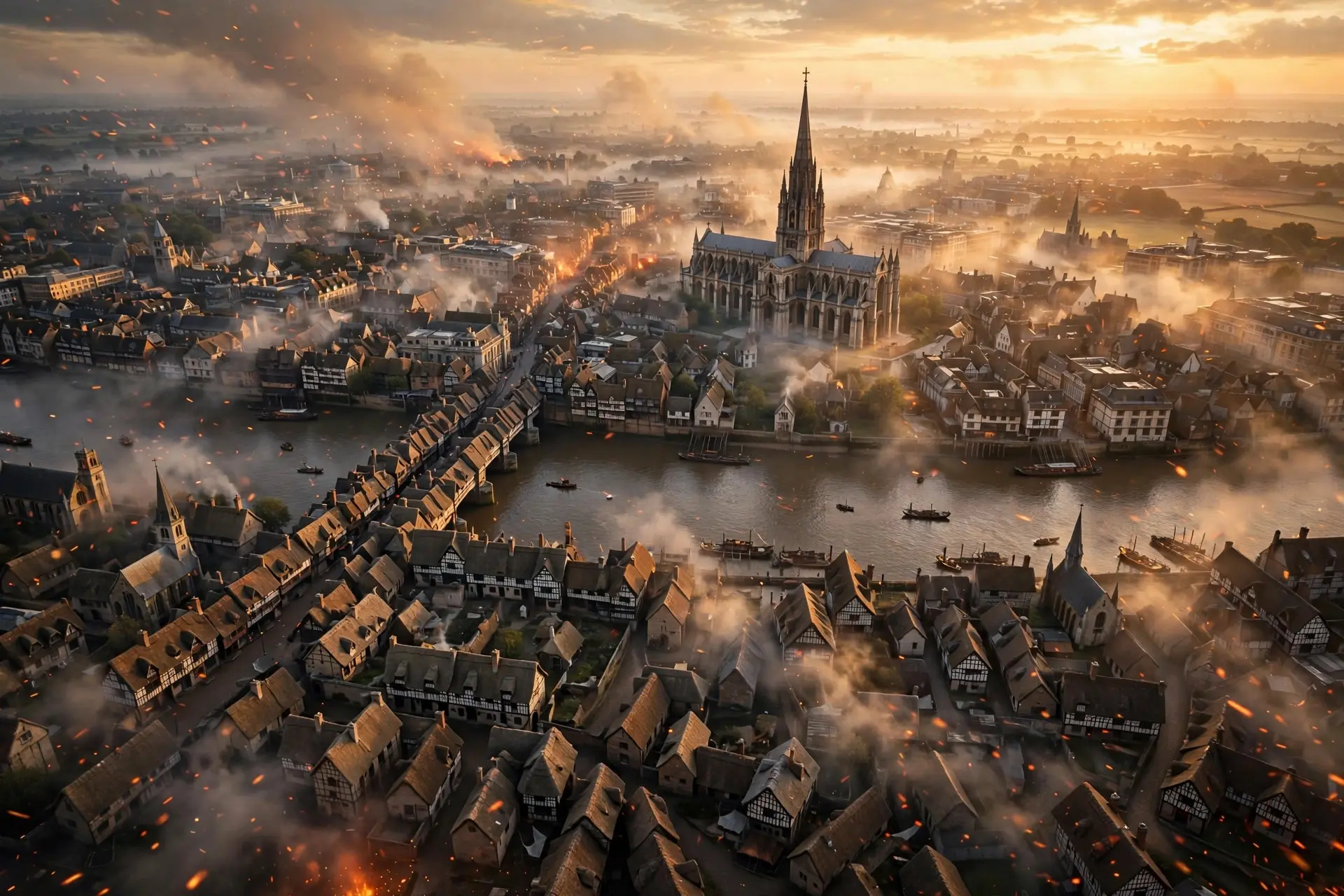
In the early hours of Sunday, September 2, 1666, a spark in the bakery of Thomas Farriner on Pudding Lane met a city that was, in effect, a bonfire waiting for a match. Four days later some 13,200 houses, 87 churches, and the great St Paul's Cathedral were gone. But the real story of the Great Fire begins in the ash — in how London seized a once-in-centuries chance to outlaw the medieval city itself.
A City Built to Burn
Seventeenth-century London was a masterpiece of flammability. Its houses were timber-framed, with upper storeys jutting out over the street — jetties — so that opposite buildings nearly touched above the narrow lanes. Warehouses crammed with pitch, hemp, and coal sat beside open hearths and thatched roofs. There was no professional fire service, only bucket chains and hand-pumped squirts. The summer of 1666 had been exceptionally hot and dry, and a strong easterly wind rose on the very night the fire began. When Lord Mayor Sir Thomas Bloodworth was woken in the small hours, he reportedly dismissed the blaze as nothing — a woman might quench it, he is said to have claimed — and went back to bed, refusing permission to pull down houses to make a firebreak. By the time the authorities acted decisively, the inferno was writing its own rules. What finally stopped it was the very method Bloodworth had refused: the King's men and the Tower garrison blew up whole streets with gunpowder, creating gaps the flames could not cross. Exhausted, starved of fuel — and helped by a dying wind — the fire was brought under control on Thursday, September 6.
Four Days That Emptied a Capital
The numbers are staggering. The fire consumed some 436 acres — roughly four-fifths of the walled City — and left between 80,000 and 100,000 people homeless, most of the City's population, camping in fields and tents outside the walls. Eighty-seven parish churches, the Royal Exchange, the Guildhall, and the medieval St Paul's all burned. It was, by any measure, one of the greatest urban catastrophes of early modern Europe — rivalled only by events like the Year Without a Summer, when a volcanic winter starved a continent.
Yet the official death toll reads six. Six recorded deaths in a fire that erased a city. Historians widely regard the number as an undercount: the parish clerks who kept the Bills of Mortality had lost their churches, the poor and lodgers were barely recorded at all, and excavations on Pudding Lane have turned up pottery melted by heat that would have left nothing of bone. The true toll is unknowable — and that unknowability itself says something about whose lives seventeenth-century London counted.
The Plans That Died on Property Lines
Rarely has a blank slate appeared so dramatically, and rarely has it been refused so firmly. Within days, the polymath architect Sir Christopher Wren and the diarist John Evelyn each produced a vision of a rational, rebuilt London: broad straight boulevards, grand piazzas, a riverside terrace — a Baroque capital to rival Paris. Neither plan survived contact with Londoners. The streets lying in ruins still represented plots of land that thousands of separate people owned — freeholds, leases, inheritances stretching back generations. Implementing Wren's plan would have required the Crown to forcibly redraw every land title in the city. King Charles II had neither the money nor the authority to attempt it, and the wealthy merchants who were simultaneously financing his war with the Dutch had one unshakeable demand: rebuild on our foundations, exactly where they were. So the 65,000 homeless did what people always do — they got on with it. Within weeks, owners were clearing debris and rebuilding on their old plots, often before any rules existed. To settle the inevitable legal chaos, Parliament set up a special Fire Court to arbitrate disputes between landlords and tenants over who should rebuild and on what terms.
The Act That Survived the Ashes
What Parliament could do, it did with unusual speed. The Act for the Rebuilding of the City of London received royal assent on February 8, 1667, and it remains one of the great exercises in disaster-driven regulation. Its key measures:
- No house was to be built of anything but brick or stone. Timber framing — the tinderbox skeleton of medieval London — was outlawed.
- Jettied overhangs were banned outright; walls had to rise straight from foundation to roof.
- Streets were sorted into four standard widths, from 100-foot quays along the river down to 14-foot alleys.
- No building could rise within 40 feet of the Thames or the Fleet River.
- Every burnt property had to be rebuilt on the same ground within three years. A commission of six — three appointed by the Crown (including Wren), three by the City (including Robert Hooke, the Royal Society's experimentalist, who did much of the daily surveying work) — staked out the new lines. Where land was taken for street widening, compensation was paid. And the whole project was financed by a temporary duty of one shilling per ton on London's coal imports — an early carbon tax, tripled in rate and extended indefinitely three years later. The result was a city that looked new but remembered the old. Ogilby and Morgan's celebrated 1676 map shows the same dense mass of winding streets that burned — the medieval street pattern survived almost perfectly beneath the new construction. Only the materials, the widths, and the silhouettes had changed. And Wren still got to leave his mark in the skyline: the baroque St Paul's Cathedral and dozens of parish churches, built in stone, rising where the timber city had stood — much as another fallen imperial capital had once been refounded in stone rather than erased.
What Disaster Can Buy
The Great Fire taught London a lesson that cities keep having to relearn: a catastrophe does not rebuild a city; it only opens a brief window in which the rules can be rewritten. Wren's Paris never happened, because property rights proved stronger than royal visions. But the 1667 Act — brick, stone, straight walls, wider streets — happened because it asked for less than a revolution and got it fast. London never burned like that again. The rebuilt city also gave birth to the world's first fire insurance industry, and with it the profession of the fire surveyor. Four centuries later, the pattern holds: disaster codes, from earthquake standards to building insulation, are almost always written in ash. Like the Titanic's sinking, which forced new maritime safety law after the wreck, the Great Fire reminds us that the most durable monument a disaster can build is not a memorial but a regulation. The medieval city is gone, but walk the City of London today and you still move through the alleys and lanes of 1666 — just wearing brick and stone instead of timber and thatch.
Frequently asked questions
How did the Great Fire of London start?
In the early hours of Sunday, September 2, 1666, a spark in Thomas Farriner's bakery on Pudding Lane ignited a city of timber-framed houses after an exceptionally hot, dry summer.
What stopped the Great Fire?
The King's men and the Tower garrison blew up whole streets with gunpowder to create firebreaks, starving the flames of fuel; a dying wind helped bring it under control on September 6.
Why wasn't London rebuilt on a new plan?
Wren's and Evelyn's grand boulevard plans died on property lines: thousands of owners demanded rebuilding on their original plots, and Charles II lacked the money and authority to redraw every land title.
How many people died in the Great Fire?
The official toll reads six, but historians regard it as an undercount - parish clerks had lost their churches, the poor were barely recorded, and excavations found heat damage consistent with unrecorded victims.