How Did Medieval Builders Lift Stone for Gothic Cathedrals?
How did medieval builders raise Gothic cathedrals? With human-powered treadwheel cranes: giant wooden wheels letting one worker hoist 3.5 tonnes of stone.
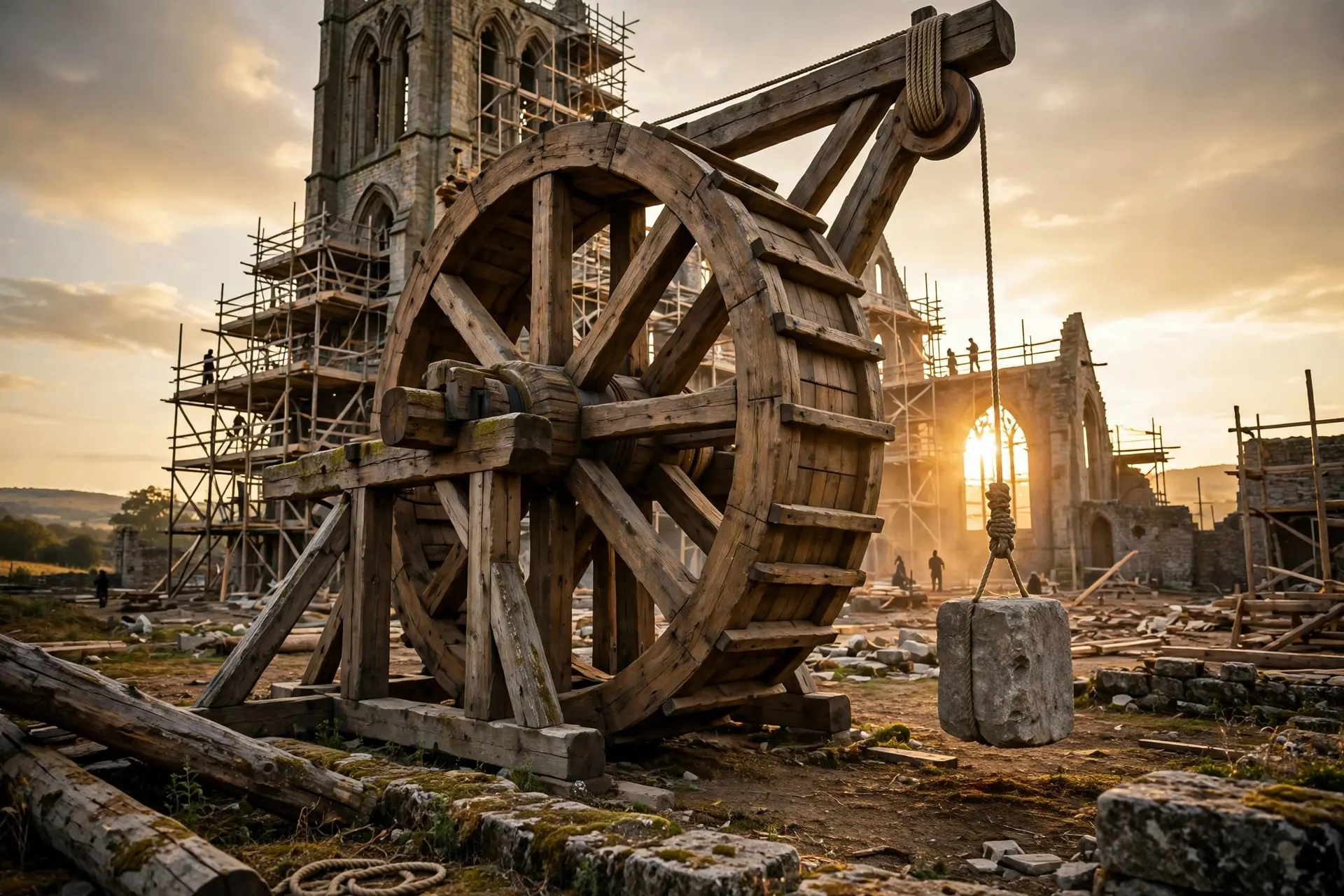
Key takeaways
- Medieval builders did use cranes: giant wooden treadwheel cranes powered by workers walking inside a wheel 3 to 5 meters across.
- A 14:1 mechanical advantage let one person pushing with about 50 kg of force hoist roughly 3.5 tonnes of stone.
- The crane traveled with the building: it was dismantled and rebuilt level by level as the cathedral rose.
- Cologne Cathedral once ran a 15.7-meter slewing crane with a 15.4-meter jib; Canterbury's 4.6-meter wheel was still used in the 1970s.
They had cranes, just no engines. Medieval builders raised cathedral stone with giant wooden treadwheel cranes, in which one or two workers walked inside a wheel 3 to 5 meters across. The wheel's mechanical advantage let a person pushing with about 50 kilograms of force hoist roughly 3.5 tonnes of stone. Gothic heights were a human-powered achievement.
- The earliest record of a treadwheel, called a magna rota, appears in France around 1225, with an illuminated manuscript depiction by 1240, just as Gothic architecture was taking off. Talk.Build
- With a 14:1 mechanical advantage, one operator could lift about 3.5 tonnes, while walking 140 meters inside the wheel to raise a load just 10 meters. Talk.Build
- Cologne Cathedral ran a slewing crane with two tread wheels rising 15.7 meters, with a rotating jib 15.4 meters long, from 1400 until its removal in 1842. Talk.Build
- Canterbury Cathedral's crane, a wheel 4.6 meters in diameter, was put back to work during renovation in the 1970s. Talk.Build
- Wheels over 4 meters across at Strasbourg and Mont Saint Michel lifted 3 tonnes with two operators inside. Talk.Build
- The crane never sat on flimsy scaffolding: it stood on the building's solid interior framework and was dismantled and rebuilt a level higher as work rose. Talk.Build
What was a treadwheel crane, exactly?
Picture a giant wooden hamster wheel, several meters across, wide enough for two people to walk side by side inside. As they walked, the wheel turned a central shaft; a rope wound around a drum on that shaft, and the rope lifted the load through pulleys and a jib. The more advanced clasp-arm design, with arms arranged as chords to the rim, let builders use a thinner shaft and squeeze out greater mechanical advantage.
The idea was not medieval at all. It descended from the Roman polyspaston, a compound-pulley crane described by the architect Vitruvius, which could lift 3,000 kilograms with four men at a windlass; fitting a treadwheel doubled that capacity with fewer operators. The machine fell out of use with the Western Roman Empire and reemerged in the 13th century, precisely when Gothic vaults started climbing past anything Rome had attempted. Builders of the great domes of antiquity faced the same lifting problem; see how the Romans raised the Pantheon's dome.
How much could one person really lift?
The numbers are startling. A crane with a 14:1 advantage meant a single person exerting the equivalent of 50 kilograms could lift roughly 3.5 tonnes, and two operators or better gearing could double that. Larger harbor cranes used pairs of wheels and up to four operators to hoist as much as 7 tonnes. Stones were gripped for the ride in a few clever ways. Finished ashlar blocks were lifted by sling, by a lewis hole (a tapered socket cut into the stone that a matching iron plug expanded into), or by a devil's clamp, a hinged tong. Loose material traveled differently: mortar, rubble, and small blocks went up in pallets, baskets, wooden boxes, or barrels. Medieval cranes had almost no brakes or ratchets. Instead, the friction of the massive wooden wheel was high enough that it would not run backward on its own; the walkers themselves controlled the descent. A crane master outside the wheel directed the whole operation, using guide ropes to nudge the load sideways, because these machines were built for vertical lifts, not horizontal travel.
How did the crane climb a 100-meter tower?
It grew with the building. The crane started at ground level inside the rising structure. Once a floor was finished and the massive tie beams of the roof connected the walls, the whole machine was taken apart and reassembled on those beams, then shifted from bay to bay as the vaults progressed. When construction ended, many cranes simply stayed where they were, ready for future repairs. That is why the surviving originals in England all sit in church towers, above the vaulting and below the roof.
The tower sites posed the hardest version of this problem. A peer-reviewed 2024 reconstruction study at the University of Debrecen shows that building 15th-century stone spires, at places like Strasbourg and Vienna, required frame hoists with ratchets set atop inner scaffolding, with stones drawn up through openings left in the vaults below; a surviving treadwheel still sits inside Freiburg's openwork spire, and circular load-transport openings remain in the vaults above its bell storey. The same study notes the tallest medieval stone towers reached 130 to 140 meters, and their builders fitted hidden metal reinforcement into the stonework to handle tension, an early ancestor of reinforced concrete. The proof that the machines worked is not just archival. At Guédelon Castle in Burgundy, France, experimental archaeologists have built a fully working 13th-century treadwheel crane using only period methods and materials, and it lifts stone, timber, and mortar on the site every building season. The 13th-century castle project has run since 1997, and lifting there is done entirely by human-powered treadwheel hoists.
What do people get wrong about medieval cranes?
Three misconceptions are common. First, that medieval builders had no cranes: they had sophisticated ones, just powered by muscle. Second, that the crane sat on the cathedral walls or the lightweight scaffolding: it did not, because neither could carry the machine plus a multi-ton load. Third, that the wheel walkers were interchangeable brute labor: each lift needed choreography between the crane master, the walkers, the ropes, and the jib, and accidents, from axle failures to falls, were a known risk. The stone those cranes carried had to be cut with remarkable accuracy. Gothic builders worked stone to fit with tolerances of less than a quarter inch (5 millimeters), laid out with straightedge and compass on full-scale templates, sometimes inscribed on the cathedral floor itself. Between the mid-12th and mid-13th centuries, scale leapt fast: Laon's nave, begun in 1175, reached 80 feet (24 meters), while Rheims, begun just 50 years later in 1225, soared to 125 feet (38 meters).
| Machine | Era | Crew | Maximum lift |
|---|---|---|---|
| Roman polyspaston (windlass) | 1st century | 4 men | ~3,000 kg |
| Roman polyspaston (treadwheel) | 1st century | 2 men | ~6,000 kg |
| Medieval construction treadwheel | 13th-15th century | 1-2 walkers | ~3,500 kg (14:1) |
| Medieval harbor double-wheel | 13th-15th century | up to 4 operators | ~7 tonnes |
| The Hagia Sophia dome engineers worked the same Byzantine pulley traditions these machines came from, and long before them, the Egyptians had their own answer to raising heavy stone (how obelisks were raised, how pyramid blocks were moved). | |||
| How we made this article: FactSpire researched and drafted it with AI assistance and checked every fact against the sources listed above. |
Frequently asked questions
Did medieval builders really have no cranes?
They had cranes without engines. The treadwheel crane, revived from Roman designs in the 13th century, used human weight inside a giant wooden wheel to lift multi-ton stones. Several survive in English church towers today.
How high could a treadwheel crane lift stone?
Construction cranes handled vaults pitched well above 20 meters. Cologne Cathedral's slewing crane stood 15.7 meters tall with a 15.4-meter jib, and large wheels at Strasbourg and Mont Saint Michel lifted 3 tonnes with two operators.
Where did the crane sit while the cathedral was being built?
It started on the ground inside the building, then was dismantled and reassembled on the roof's tie beams once they were in place. It moved bay by bay with the masons, which is why surviving cranes rest in church towers above the vaulting.
Can you see a working medieval crane anywhere today?
Yes. Guédelon Castle in Burgundy, France has built a working 13th-century treadwheel crane as part of its experimental-archaeology castle build, and it lifts stone and timber daily using only period methods.
Sources
- The story behind medieval cranes powered by 'Human Hamsters', Talk.Build
- Construction of a Gothic Church Tower: A 3D Visualisation Based on Drawn Sources and Contemporary Artefacts, MDPI (University of Debrecen, Department of Civil Engineering)
- The Technology of Construction, Encyclopedia.com
- Guédelon Castle: A Medieval Castle Built From Scratch, ArchitectureCourses.org