How Did the Romans Build the Pont du Gard Aqueduct?
The Pont du Gard rises 49 m (161 ft) over a French river with no mortar in its joints. How was the Pont du Gard built, and who were the 1,000 men behind it?
Key takeaways
- About 1,000 workers built the Pont du Gard in roughly five years during the 1st century AD.
- The bridge stands 48.8 m (160 ft) tall and was assembled without mortar, held by friction and gravity.
- Its aqueduct dropped only 12 m (39 ft) over 50 km, delivering 40,000 cubic metres of water a day.
- The 25 m central arch needed one of the largest wooden scaffolds ever built in the ancient world.
In the first century AD, roughly a thousand workers stacked limestone blocks 49 metres (161 feet) into the sky over the Gardon River and made them hold without a drop of mortar. The Pont du Gard then carried 40,000 cubic metres (10.6 million US gallons) of water a day across a 50 km (31 mile) aqueduct that drops just 12 metres (39 feet) end to end.
- The official Pont du Gard site says construction needed about a thousand men working for nearly five years, a genuine engineering sprint by ancient standards.
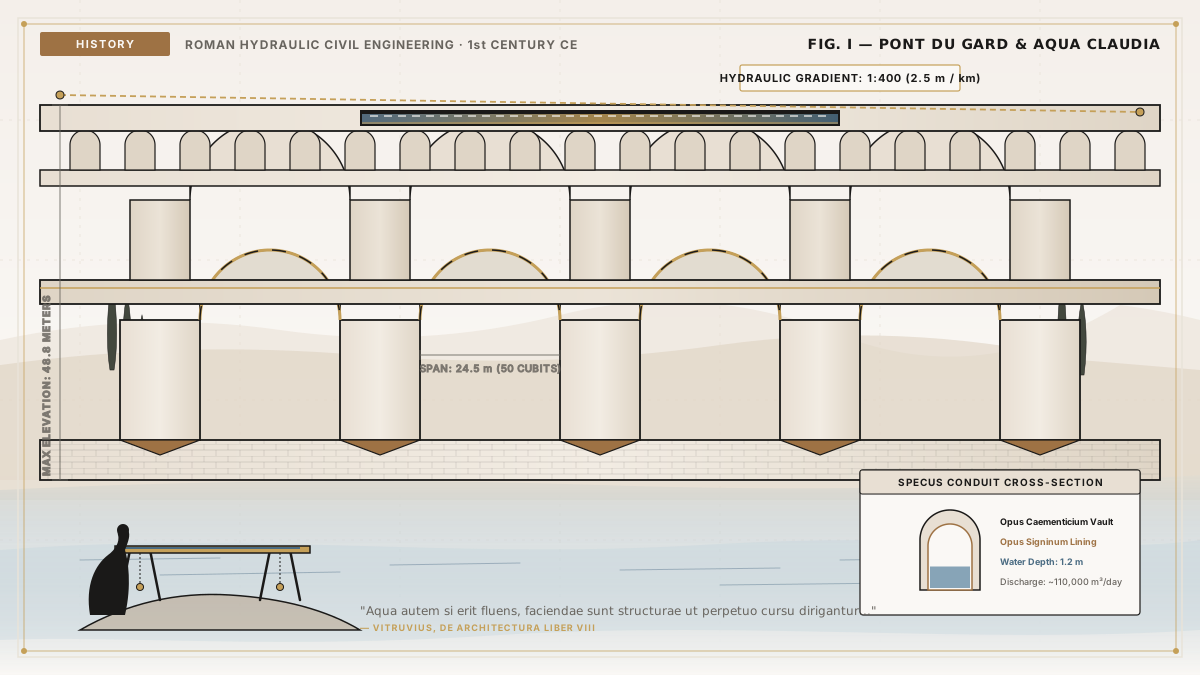
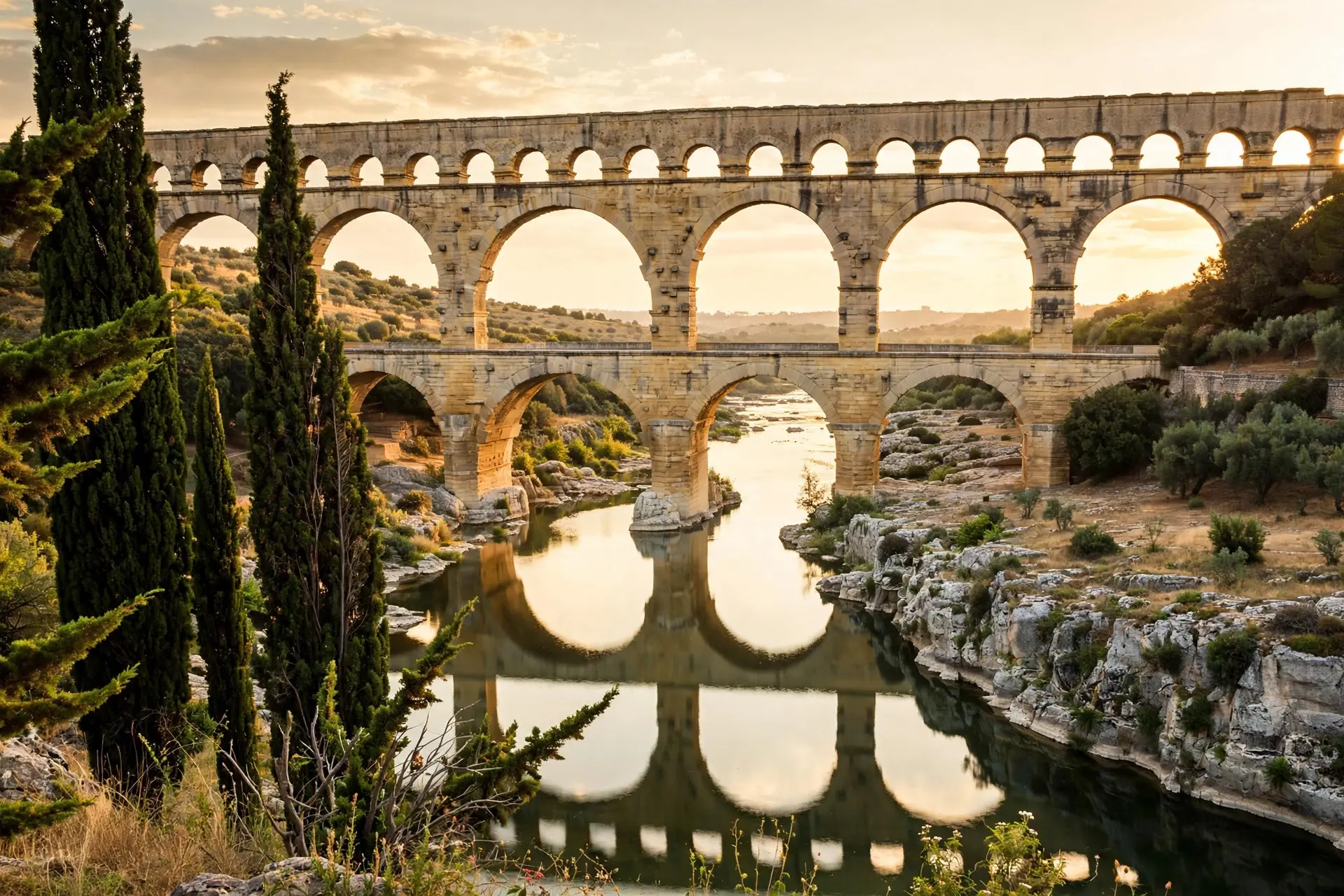
- The bridge is 48.8 m (160 ft) high and 275 m (902 ft) long, the tallest aqueduct bridge ever built in the ancient world.
- It was assembled almost entirely without mortar, with precisely cut blocks, some weighing up to six tonnes, held by friction and gravity.
- The central arch spans 25 m (82 ft), and the Romans built one of the largest wooden centering structures in the world to hold it up while it was finished.
- The whole aqueduct slopes an average of 24 cm (9.4 inches) per kilometre over 50 km, a total drop of just 12 m (39 ft).
- The covered water channel on top measured 1.8 m (5.9 ft) high by 1.2 m (3.9 ft) wide, with a gradient of only 2.5 cm (1 inch) across the bridge itself.
How was the Pont du Gard built?
Everything started at a quarry about 600 metres downstream, where roughly 120,000 cubic metres of shelly limestone were cut from the cliff face. Archaeologists can still see the imprint of the extracted blocks there, along with marks from the picks of the quarry workers. Each block was shaped to lock with its neighbours, and many still carry the builders' positioning marks.
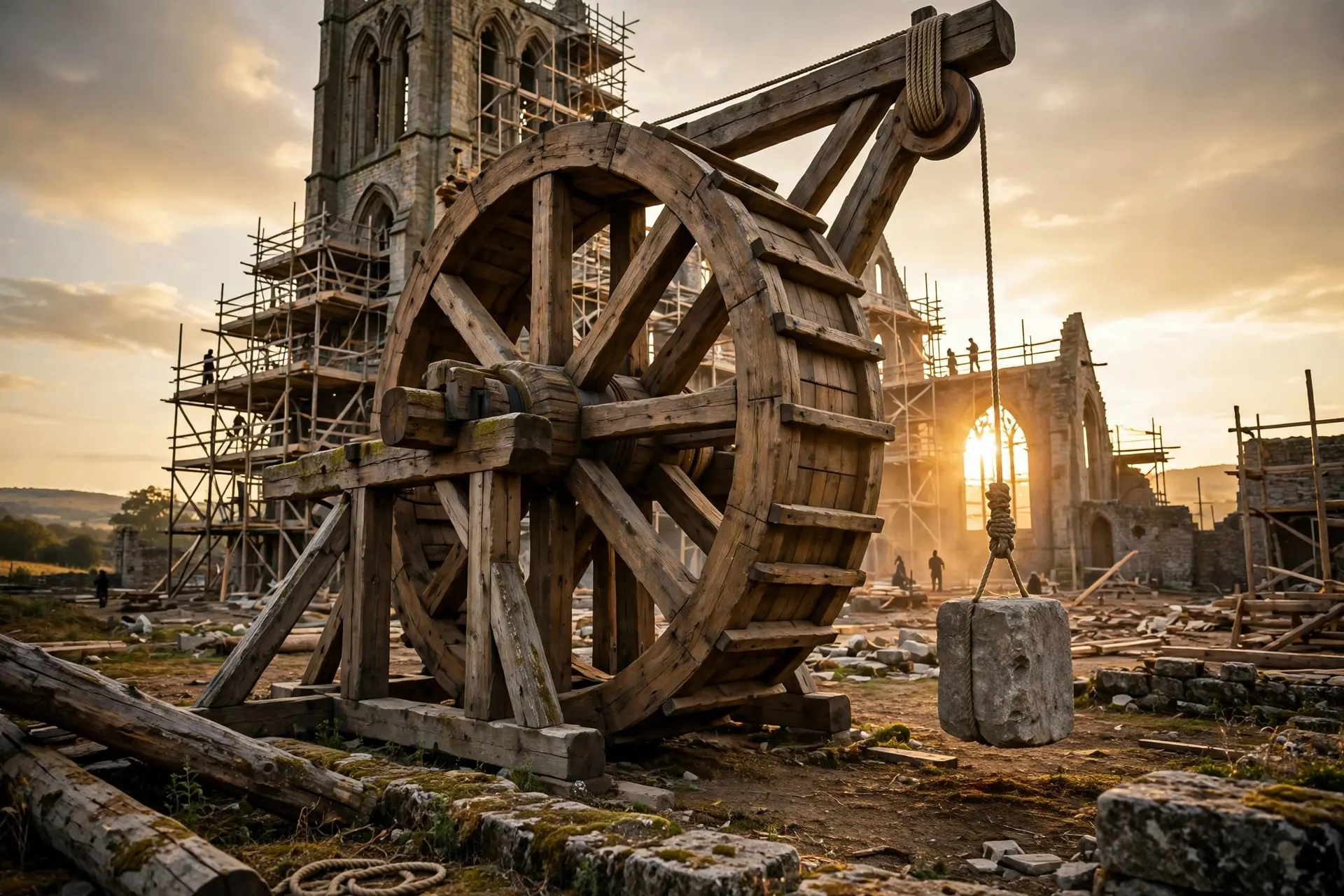
The blocks were hoisted into place using wooden devices that archaeologists only fully understood after floods in 2002 exposed traces of them on the riverbanks. The projecting stones still visible on the bridge's faces were not decoration: they held the wooden scaffolding the masons stood on. For the great central arch, the Romans built an enormous timber centering, a wooden skeleton arch, that supported the stones until the arch could support itself. The official site calls it one of the largest such structures ever built. At the summit runs the specus, the covered water channel. Its walls were lined with waterproof material, and a red coating found on the channel walls turned out, under chemical analysis, to be red sand mixed with lime. The Roman writer Vitruvius had claimed the recipe was cow's blood and fig sap, but the archaeologists' lab work disagreed. A Latin inscription found at the site reads "mens totum corium," meaning the entirety of the work has been measured, perhaps a quiet signature from the architect whose name is lost.
How did the Romans get the water to flow so gently?
The Nimes aqueduct runs 50 km (31 miles) from springs near Uzes, and most of it is buried underground, following the land's contours. Water moves by gravity alone, which means the slope has to be exactly right: too steep and the flow tears the channel apart, too shallow and the water stalls. The Roman surveyors held the channel to an average drop of 24 cm (9.4 inches) per kilometre, among the shallowest gradients ever achieved at the time, for a total fall of only 12 m (39 ft) over the whole route. On the bridge itself, the channel falls just 2.5 cm (1 inch) across the entire 275 m (902 ft) span. The result was a steady delivery of about 40,000 cubic metres (10.6 million US gallons) a day to the fountains, baths and homes of Roman Nimes, though flow had dropped to about 35,000 cubic metres a day by the third century as maintenance slipped.
Timeline: 2,000 years of the Pont du Gard
| Date | What happened |
|---|---|
| 1st century AD | Built to carry water from Uzes to Roman Nimes |
| 4th century | Maintenance stops; mineral deposits start clogging the channel |
| ~6th century | Water flow ends; the bridge becomes a toll crossing |
| 1699–1702 | Architects Laurens and d'Aviler strengthen piers and add corbels |
| 1743–1747 | Engineer Henri Pitot builds a road bridge against the lower tier |
| 1840 | Listed on France's first register of historic monuments |
| 1855–1858 | Major restoration under architect Charles Laisne, under Napoleon III |
| 1985 | Inscribed as a UNESCO World Heritage Site |
| 1992–2005 | Full restoration campaign on all three tiers |
| 2000 | Visitor centre opens; traffic removed from the ancient bridge |
| All dates and events come from the sources listed below; the flow-stop and medieval toll-bridge details are confirmed by both Grand Sud Insolite and the World Heritage Journeys interview. |
What most people get wrong about the Pont du Gard
"The Romans used secret Roman concrete." The famous Roman concrete went into the channel's waterproof lining, not the bridge itself. The arches are dry stone: no mortar at all between the blocks. What holds a six-tonne block in place is the exactness of the cut plus the weight of everything above it. "It was built by slaves alone." The workforce is usually estimated at around a thousand men, and the skill range had to be enormous, from quarry cutters to surveyors who could hold a 24 cm-per-kilometre gradient across 50 km of rough country. This was a professional construction site, not brute labour alone. "It carried water continuously until modern times." Not close. The water had stopped by roughly the sixth century, and studies of the deposits on the channel walls show the late Roman water was muddy and unsafe to drink. The bridge survived because it was useful as a crossing: medieval lords collected tolls on it, which gave them a reason to keep it up, and in the Renaissance travellers simply rode across the second tier, whose piers were hollowed out for the traffic. "UNESCO listing is what saved it." The 1985 inscription was late in the story. The real rescue began in 1840, when the bridge entered France's first list of historic monuments and conservation became official policy.
Why the Pont du Gard still matters
Two thousand years on, the bridge works as a benchmark: a water channel 1.8 m high, 1.2 m wide, falling one inch over 275 m, delivering millions of gallons a day with no pump and no mortar. Read it alongside the wider network of Roman aqueducts, the ancient Greek tunnel of Eupalinos and China's Dujiangyan irrigation system, and the Pont du Gard looks less like a miracle and more like a habit: ancient engineers, wherever they lived, treated water as a problem to be measured, not wished away. How we made this article: FactSpire researched and drafted it with AI assistance and checked every fact against the sources listed above.
Frequently asked questions
How was the Pont du Gard built without mortar?
Workers cut shelly limestone blocks so precisely that they lock together through friction and gravity alone. Builders left projecting blocks in the faces to hold wooden scaffolding, and the pieces fit tightly enough that the bridge has survived floods, earthquakes and wars for nearly 2,000 years.
How long did it take to build the Pont du Gard?
The official Pont du Gard site estimates that about a thousand men worked for nearly five years. Some modern estimates stretch the timeline longer, but all sources agree the work was done in the first century AD.
How much water did the Pont du Gard carry?
The Nimes aqueduct delivered an estimated 40,000 cubic metres (10.6 million US gallons) of water a day from the springs near Uzes to the fountains, baths and homes of Roman Nimes, running downhill the entire way by gravity alone.
Is the Pont du Gard still standing because Romans maintained it?
No. Maintenance stopped after the 4th century and the flow ceased around the 6th century. The bridge survived because medieval lords used it as a toll bridge, which gave them a reason to keep it standing for centuries.
Sources
- Patrimoine mondial UNESCO | Pont Du Gard, Pont du Gard official site
- Uncovering Pont du Gard's archaeological secrets, World Heritage Journeys
- The Pont du Gard, a whole story, Grand Sud Insolite
- Pont du Gard Travel Guide, Eupedia