How Did the Hanging Gardens of Babylon Get Their Water?
Ancient texts say screws lifted water from the Euphrates, but new research points to Nineveh. How did the Hanging Gardens of Babylon get their water?
Key takeaways
- Ancient writers describe water screws lifting river water to the garden's upper terraces.
- No Babylonian text mentions the gardens, and no certain trace has ever been found at Babylon.
- Oxford's Stephanie Dalley spent 18 years arguing the garden stood at Nineveh, built by Sennacherib.
- Sennacherib's inscriptions describe a bronze water-raising screw, four centuries before Archimedes.
The best-supported answer is bronze screws: a water-raising screw, described in a 7th-century BC Assyrian inscription, that lifted water to the garden's upper terraces centuries before Archimedes was born. The catch is that the garden those screws watered may never have stood in Babylon at all, but in Nineveh, 300 miles (483 km) to the north.
- The traditional story says King Nebuchadnezzar II (reigned c. 605–561 BCE) built the gardens around 600 BC for his Median wife Amytis, who missed the mountains of her homeland.
- No Babylonian writings mention the gardens, and no conclusive archaeological proof has ever been uncovered at Babylon's ruins near Hillah, Iraq.
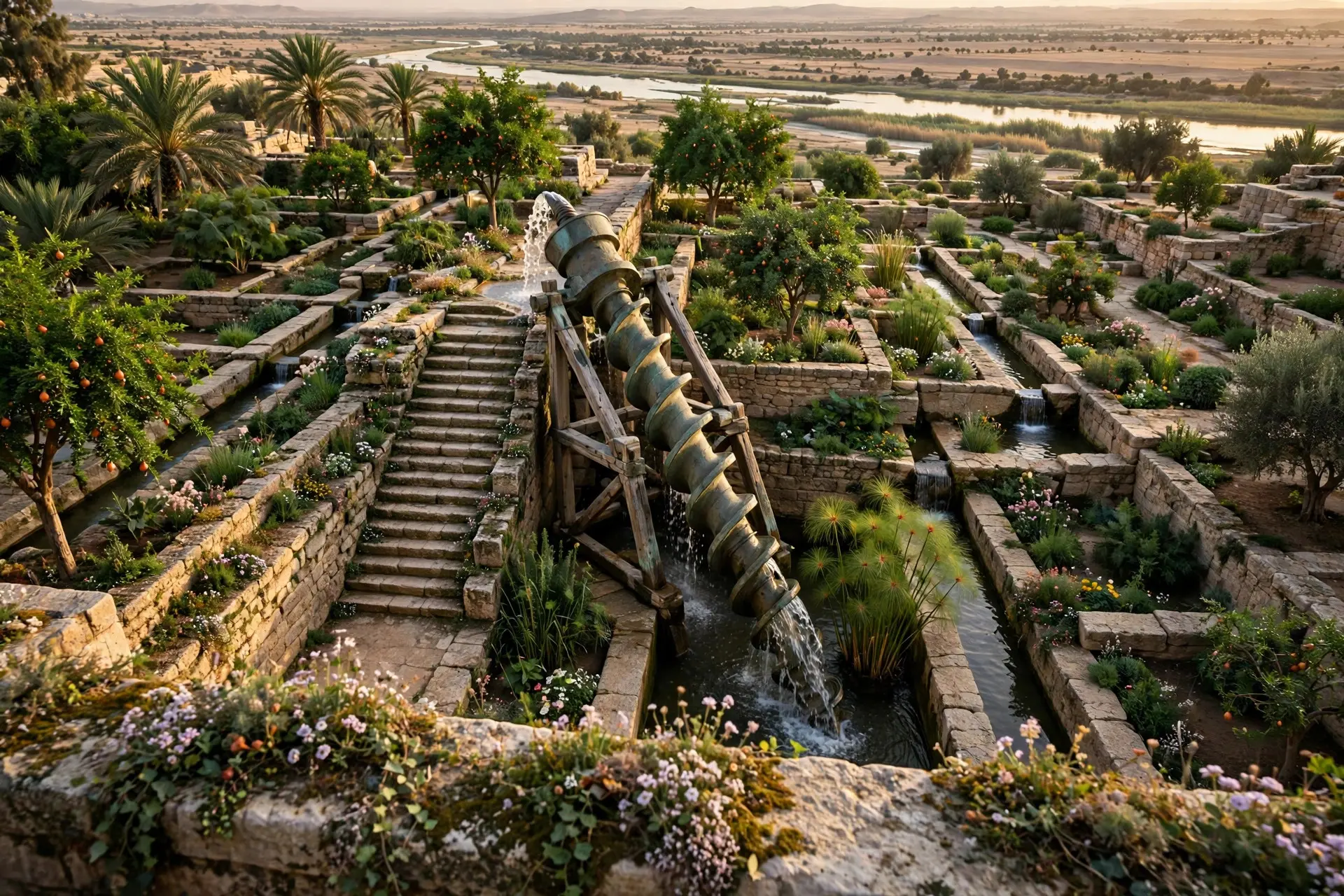
- Greek and Roman writers described the gardens watered by an ingenious irrigation system known today as an Archimedes screw, with Strabo noting the screws drew water from the Euphrates.
- After 18 years of study, Oxford's Stephanie Dalley concluded the garden was built at Nineveh by the Assyrian king Sennacherib in the early 7th century BC.
- Sennacherib's own inscriptions describe a bronze water-raising screw made with a new casting method, predating Archimedes' screw by some four centuries.
- His water system brought mountain water from 50 miles (80 km) away through canals, dams and aqueducts, with water drawn up "all day."
What did the ancient sources say about the water?
The classical accounts agree on the essentials. The gardens rose in terraces near the royal palace, plants cascading from vaulted levels, and water arrived from the river through machines nobody outside could see working. Diodorus wrote that the machines raised water "in great abundance" from the river; Strabo described screws continually drawing water up into the garden. The terraces themselves were engineered to hold water: classical writers describe roofs layered with reeds, bitumen and lead so irrigation water would not seep through into the galleries below. German archaeologist Robert Koldewey even found an unusual series of foundation chambers and vaults in Babylon's palace, with a well that may have worked with a chain pump, though Britannica stresses no certain traces have been found.
The problem is distance. These writers lived centuries after the supposed building, and none had seen the gardens. The first mention comes from Berossus, a Babylonian priest writing around 290 BC, and even that survives only through the later Roman historian Josephus. Berossus is the sole source pinning the garden on Nebuchadnezzar, and scholars note the attribution may have been added by later writers quoting him.
Why do researchers now point to Nineveh?
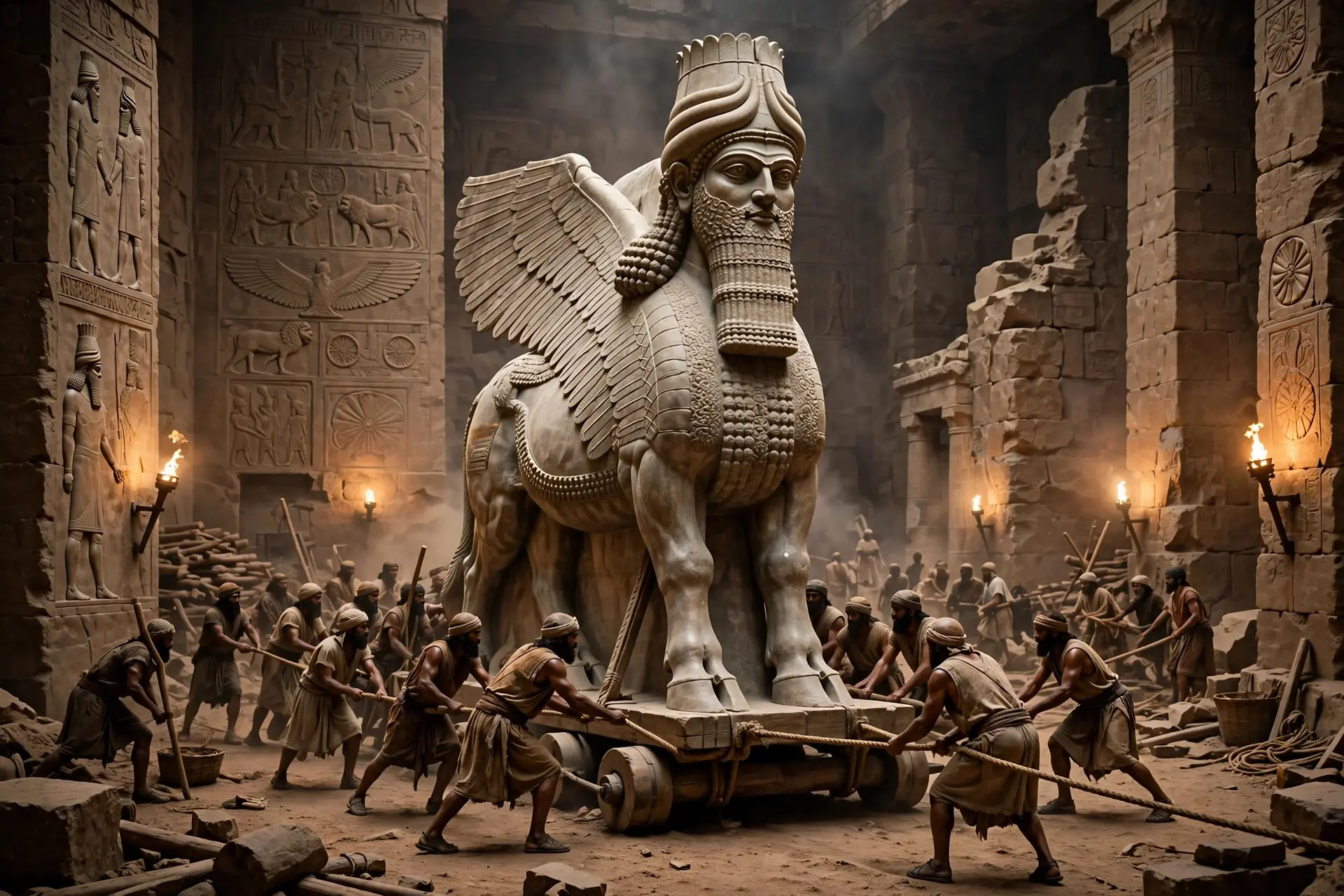
Stephanie Dalley, an Oxford specialist in ancient Mesopotamian languages, spent nearly two decades re-reading the cuneiform record and found something the Greek writers missed: an Assyrian king boasting about a garden of his own. In a 7th-century BC inscription, Sennacherib described his "unrivalled palace" and a garden that was "a wonder for all peoples," complete with that bronze water-raising screw. The physical evidence backs the texts. In the 19th century, the archaeologist Austen Henry Layard unearthed stone panels at Nineveh showing lush terraced gardens fed by aqueducts. Excavations have found traces of a vast aqueduct system, one stretch so large that Dalley said its remains looked like a motorway from the air, carrying an inscription: "Sennacherib king of the world... Over a great distance I had a watercourse directed to the environs of Nineveh." Unlike flat Babylon, the rugged land around Nineveh could actually hold a terraced mountain-garden. Dalley's 2013 book, The Mystery of the Hanging Garden of Babylon, argues the whole wonder was misfiled: after Nineveh's destruction in 612 BC, its garden was reassigned to Babylon, the city everyone remembered.
How would the bronze screws have worked?
A water screw is a spiral inside a tilted tube. Turn the tube, and the spiral traps pockets of water and carries them uphill, a simple, continuous pump. Sennacherib's inscription claims his version was cast in bronze using a new method, and that it lifted water "all day" to the garden's terraces. The system behind it mattered as much as the screws. Dalley describes canals, dams and aqueducts bringing mountain water from streams 50 miles (80 km) away to Nineveh's citadel. The gardens themselves had terraces, pillared walkways, exotic plants and rippling streams. Once water reached the top, gravity did the rest, spilling it down through the levels. For scale, picture the challenge: lifting a steady flow of water tens of metres into the air, every day, in a desert climate, with nothing but muscle, bronze and geometry. That is the engineering the ancient writers found wonderful, and the detail they kept repeating.
Two accounts of the Hanging Gardens compared
| Traditional Babylon account | Dalley's Nineveh account | |
|---|---|---|
| Builder | Nebuchadnezzar II | King Sennacherib |
| Date | ~600 BC | Early 7th century BC (Sennacherib ruled 705–681 BCE) |
| Location | Babylon, near the royal palace | Nineveh, 300 miles (483 km) north |
| Water source | The Euphrates River | Mountain streams 50 miles (80 km) away |
| Lifting machine | Screws described by Strabo and Diodorus | Bronze screw in Sennacherib's own inscription |
| Evidence | Greek and Roman texts, centuries later | Cuneiform prisms, reliefs, aqueduct remains |
| Sources: Britannica and Discovery UK for the Babylon account; the Assyrian International News Agency's report on Dalley's research for the Nineveh account. |
What most people get wrong about the Hanging Gardens
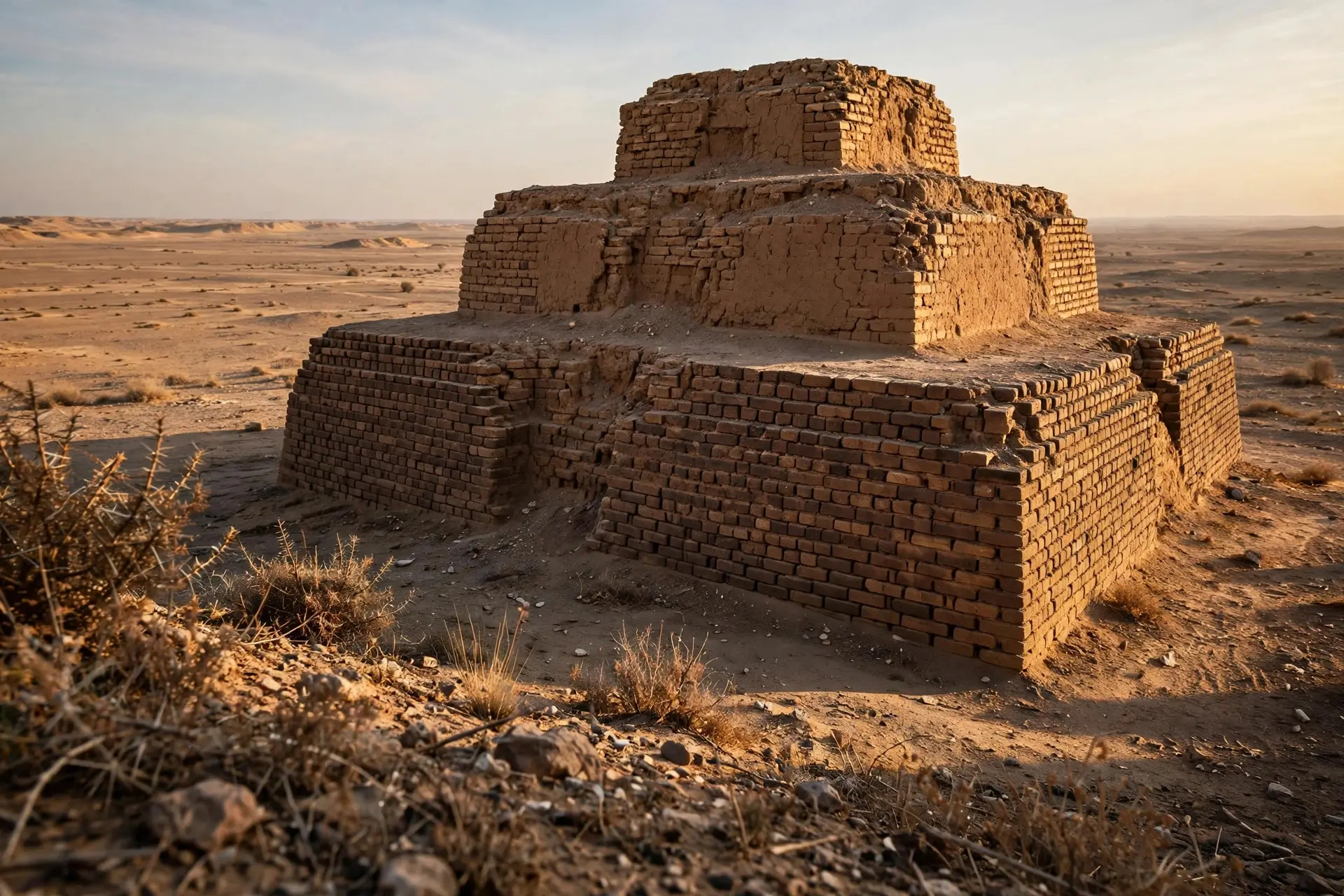
"They definitely existed in Babylon." No Babylonian source mentions them, and decades of excavation at Babylon found nothing conclusive. Their existence is still debated, which makes them the only one of the Seven Wonders without a confirmed site. "Archimedes invented the water screw." Strabo's account of the gardens describes screws raising water, and Sennacherib's bronze version predates Archimedes by about four centuries. Like several inventions credited to the Greeks, the screw may be Mesopotamian in origin. "The gardens hung from chains or ropes." "Hanging" is a mistranslation of sorts: the plants cascaded over terraced roofs. Some researchers think the gardens were rooftop gardens on ziggurat-style terraces, irrigated by pumps from below, which is closer to the ancient qanat tradition of moving water through dry land than to anything dangling. "It was just decoration." Whoever built it, the garden was a statement of control over nature: a mountain of greenery in the desert, watered uphill by machines. The Persians later built desert ice houses and China built the Dujiangyan irrigation system on the same instinct, that water engineering was power made visible.
What we can honestly say
Two things are solid: ancient writers consistently describe a terraced garden watered uphill by screws or pumps, and an Assyrian king left inscriptions describing exactly such a machine. Whether those two facts describe the same garden is the open question. The water, at least, is no mystery: bronze screws, all day, every day, lifting a river into the sky. How we made this article: FactSpire researched and drafted it with AI assistance and checked every fact against the sources listed above.
Frequently asked questions
How did the Hanging Gardens of Babylon get water?
Ancient accounts describe machines, likely water screws, raising river water to the upper terraces, where gravity then distributed it downward. Newer research argues the garden was actually at Nineveh, where King Sennacherib's inscriptions describe bronze screws lifting water all day through canals and aqueducts.
Did the Hanging Gardens of Babylon really exist?
No one knows for certain. No Babylonian writings mention them and no conclusive archaeological proof has ever been found at Babylon's ruins. Greek and Roman writers described them in detail, but most wrote centuries later and never saw them.
Who built the Hanging Gardens of Babylon?
Tradition credits King Nebuchadnezzar II, around 600 BC, with building them for his wife Amytis. Oxford researcher Stephanie Dalley instead credits the Assyrian king Sennacherib, who ruled 705 to 681 BC, and places the garden at Nineveh, 300 miles (483 km) north of Babylon.
What was the Archimedes screw used for in the gardens?
Ancient writers say screws lifted water from the river to the top of the terraced garden. Remarkably, Sennacherib's own inscriptions describe a bronze water-raising screw made with a new casting method, some four centuries before Archimedes was born.
Sources
- Hanging Gardens of Babylon, Britannica
- Elevated Elegance: Searching for the Truth of the Hanging Gardens of Babylon, Discovery UK
- Hanging Gardens of Babylon Were Actually 300 Miles Away in Nineveh, Assyrian International News Agency