How Did the Aztecs Build Tenochtitlan on Lake Texcoco?
How did the Aztecs build Tenochtitlan on a lake? On a swampy islet they raised chinampa beds, laid three causeways, and piped spring water by aqueduct.
Key takeaways
- Founded in 1325 on a swampy islet in Lake Texcoco, Tenochtitlan grew by raising chinampa beds and filling the ground between them.
- Three causeways, Tepeyac, Iztapalapa and Tacuba, joined the island to the mainland, with removable bridges for canoes and defense.
- Twin terracotta aqueducts over 2.5 miles (4 km) long carried fresh spring water from Chapultepec into the city.
- With more than 200,000 residents, it ranked among the largest cities in the world in 1519, bigger than London.
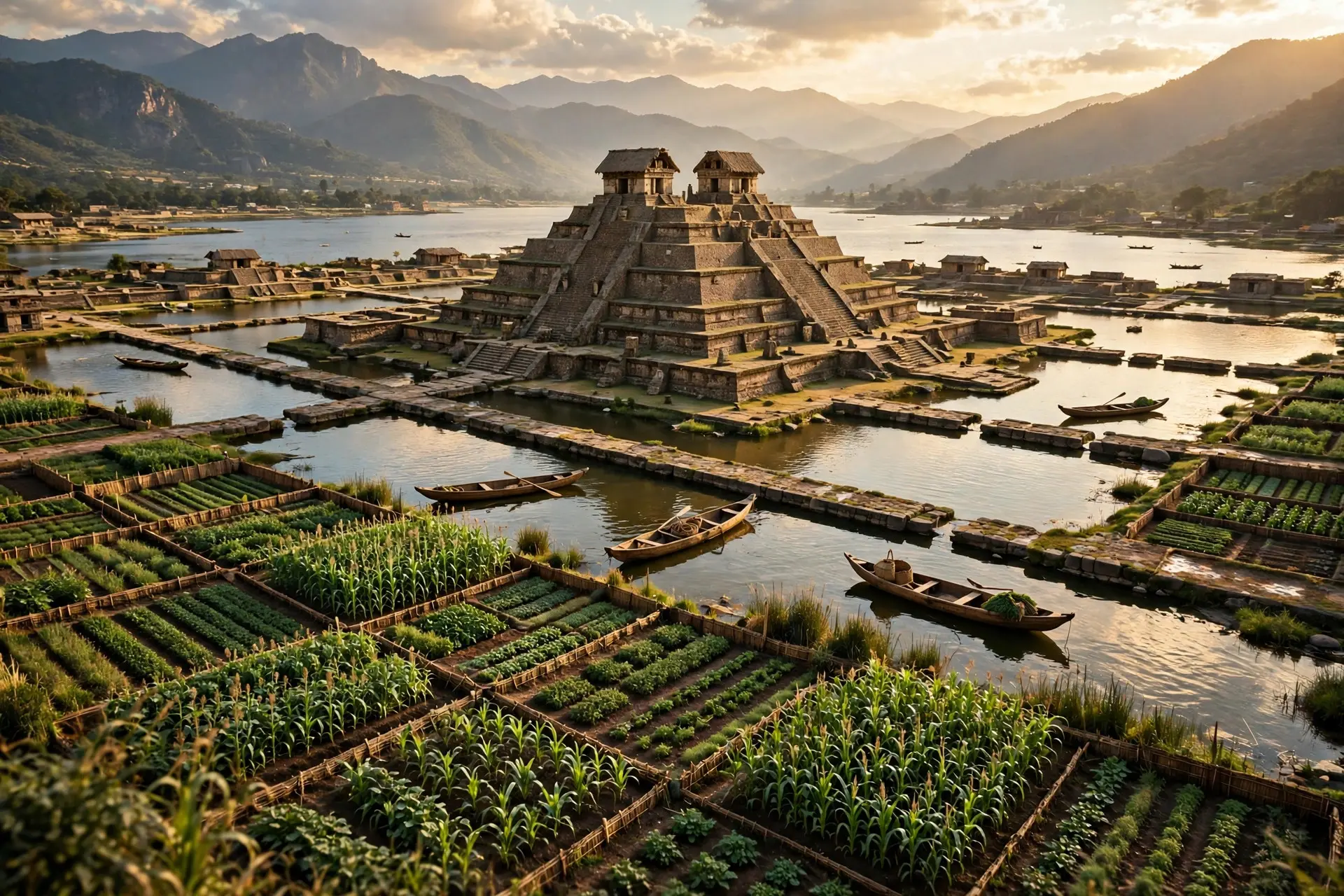
The Aztecs built Tenochtitlan by turning the lake into land. Starting from a swampy islet in Lake Texcoco in 1325, they raised chinampa garden beds from the shallows, filled ground between them, and joined the island to shore with three causeways. Fresh spring water arrived by aqueduct, and the city grew to over 200,000 people.
Key facts
- In 1325 the Mexica founded Tenochtitlan on a swampy islet in Lake Texcoco, after a migration of more than 200 years; they settled as tribute-paying subjects of the Tepanec rulers of Azcapotzalco. (Arqueología Mexicana, Secretaría de Cultura / INAH)
- The city covered 3.1 to 5.2 square miles (8 to 13.5 km²) on the western side of the shallow lake. (Humanities LibreTexts)
- Modern estimates put the population at 212,500, the fourth-largest city in the world in 1519 after Paris, Venice and Constantinople, with some counts reaching 350,000. (Humanities LibreTexts)
- Three causeways joined the island to the mainland: Tepeyac to the north, Iztapalapa to the south, and Tacuba to the west, each with removable bridge sections for canoes and defense. (Secretaría de Cultura / INAH)
- Two double aqueducts, each more than 2.5 miles (4 km) long and built of terracotta, carried fresh spring water from Chapultepec into the city. (Humanities LibreTexts)
- The great market at Tlatelolco drew a reported 60,000 buyers and sellers on its main market day. (Encyclopaedia Britannica)
- The sacred precinct measured about 500 meters (1,640 feet) per side and held nearly 78 temples and religious structures; the principal pyramid platform stood 100 feet (30 meters) high. (Arqueología Mexicana, Encyclopaedia Britannica)
What did the Mexica find when they reached the lake?
After a migration of more than two centuries from the north, the Mexica reached the Valley of Mexico: a broad basin ringed by mountains and holding five interconnected lakes. The good shoreline was already taken. What remained was a small, swampy islet in brackish Lake Texcoco, controlled by the Tepanec rulers of Azcapotzalco, to whom the newcomers paid tribute for the right to settle. Their own history says the god Huitzilopochtli marked the spot with a sign: an eagle perched on a prickly-pear cactus, the image now carried on Mexico's flag. They raised a modest shrine to Huitzilopochtli on the islet and divided the ground into four quarters — Moyotlan, Teopan, Atzacoalco and Cuepopan. From that shrine the city grew outward in a grid, with long causeways aimed at the directions of the universe, a plan echoing the older metropolis of Teotihuacan.
How do chinampas turn water into farmland?
The islet could never feed a city, so the Mexica farmed the lake itself. Chinampas, often misnamed "floating gardens," were long raised beds set on the shallow lake bottom and built up from lake mud, staying moist from below and renewed with decaying vegetation. They did not drift; they were anchored farmland. Around the city they formed a green ring of intensive gardens, and whole neighborhoods outside the ceremonial walls stood on regularly laid-out chinampas, according to Mexico's heritage registry. Canals threaded between the beds, so every district could be reached on foot or by canoe, and the lake itself became the city's highway. Combined with tribute flowing in from conquered towns, the system fed a population in the hundreds of thousands, an agricultural engine as deliberate as any ancient irrigation works.
How did a city on a brackish lake get fresh water?
Lake Texcoco was brackish, so the city imported its fresh water rather than drinking from the lake. The answer was the aqueduct: two double channels, each more than 2.5 miles (4 km) of terracotta, running from the springs at Chapultepec to the city. The doubling was practical engineering. One channel could be shut for cleaning while the other kept flowing, so the supply never stopped. Mexico's heritage registry also records supply lines from Coyoacán and Azcapotzalco. The same care for water appears across the ancient world, from Maya rainwater reservoirs to Roman aqueducts, but few cities depended on imported water as completely as Tenochtitlan did.
What do people get wrong about Tenochtitlan?
| Claim | What the evidence shows |
|---|---|
| The "floating gardens" floated on the lake. | Chinampas were anchored raised beds built on the shallow lake bottom: productive farmland, not rafts. |
| The Aztecs chose the lake for its beauty. | The islet was marginal land. They settled it as tribute-paying subjects of the Tepanecs and engineered their way upward from a swamp. |
| It was a small ceremonial center. | At 3.1 to 5.2 square miles with 200,000-plus residents, a street grid, canals, schools and markets, it ranked among the largest cities on earth in 1519. |
| When Hernán Cortés arrived on November 8, 1519, his men were stunned by what the swamp had become: a stone city rising from the water, its causeways crowded, its market roaring. Two years later it was conquered and systematically dismantled, and the capital of New Spain rose on its ruins. The achievement stands apart from even the great mud-brick monuments of the Old World, such as the ziggurats of Sumer: where others built on solid ground, the Mexica manufactured their ground first. A tribute-paying people on a borrowed swamp built, in under two centuries, one of the largest cities on earth — not by finding land, but by making it. | |
| How we made this article: FactSpire researched and drafted it with AI assistance and checked every fact against the sources listed above. |
Frequently asked questions
Were the chinampas really floating gardens?
No, the name is a misnomer. Chinampas were long raised beds anchored on the shallow lake bottom, built up from lake mud and kept moist from below. They were productive farmland threaded with canals, not rafts drifting on the water.
How did Tenochtitlan compare with European cities?
With about 212,500 residents it was the fourth-largest city in the world around 1519, behind Paris, Venice and Constantinople, and some estimates run to 350,000. Counting the whole lakeside settlement complex, Britannica puts the figure near 400,000.
Where did the city's fresh water come from?
Twin terracotta aqueducts, each more than 2.5 miles (4 km) long, carried spring water from Chapultepec into the city. Mexico's cultural heritage registry also records supply lines from Coyoacan and Azcapotzalco, so the city never depended on the brackish lake.
Can you still see Tenochtitlan today?
Its ruins lie beneath central Mexico City. The Templo Mayor, the city's great twin pyramid, was rediscovered in the early 20th century and systematically excavated between 1978 and 1982. Much of what we know comes from those digs.
Sources
- Templo Mayor, Secretaría de Cultura / INAH
- 18.7: The Aztecs, Humanities LibreTexts
- Pre-Columbian civilizations - Aztec, Mesoamerica, Tenochtitlan, Encyclopaedia Britannica
- Tenochtitlan, Arqueología Mexicana