How Roman Aqueducts Moved Water Uphill Without Pumps
How did the Romans move water uphill? They never did. Aqueducts ran downhill on a tiny gradient, and valleys were crossed with pressure-fed inverted siphons.
Key takeaways
- Roman aqueducts never moved water uphill: every line ran downhill from a high spring, so gravity did all the work and no pumps were needed.
- The Nîmes aqueduct drops just 12.27 m (40.3 ft) over 50 km (31 miles), a gradient of 24 cm (9.4 in) per kilometer.
- Deep valleys were crossed with inverted siphons: sealed lead pipes that dipped down one slope and rose up the other by water pressure.
- The deepest known siphon, the Greek-built Madradag at Pergamon, ran 190 m (623 ft) deep and produced about 19 atmospheres of pressure.
- Romans did own water-lifting machines like the noria and the Archimedes screw, but used them for wells and local lifts, never for aqueduct trunk lines.
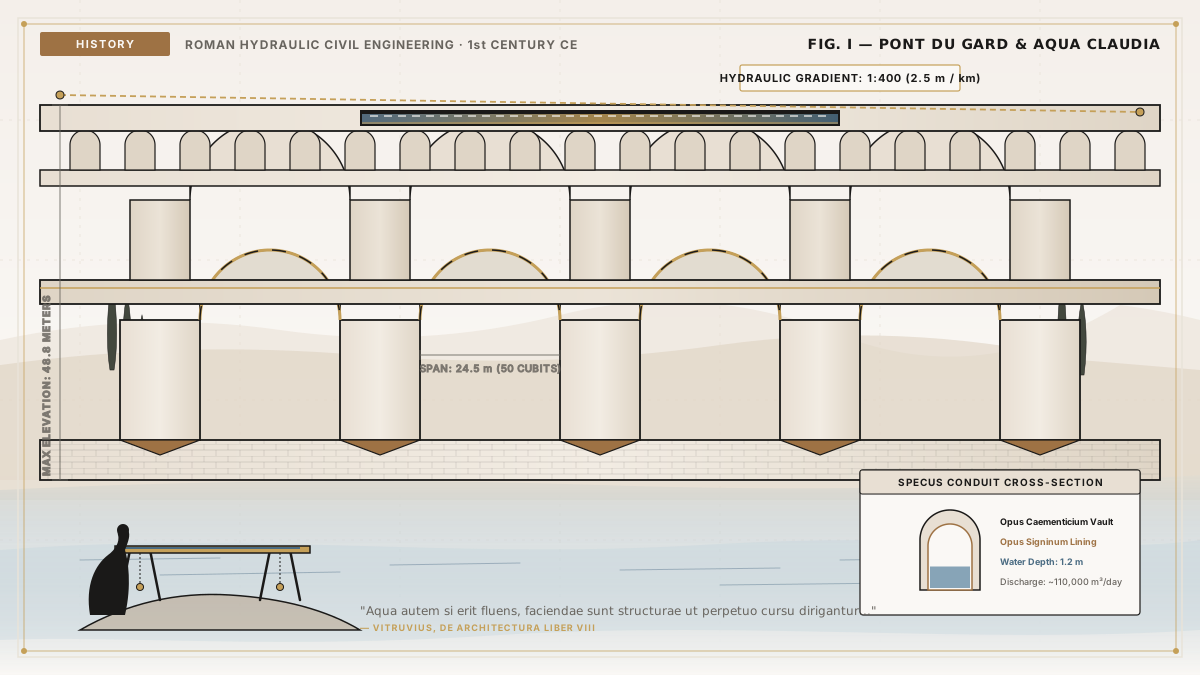
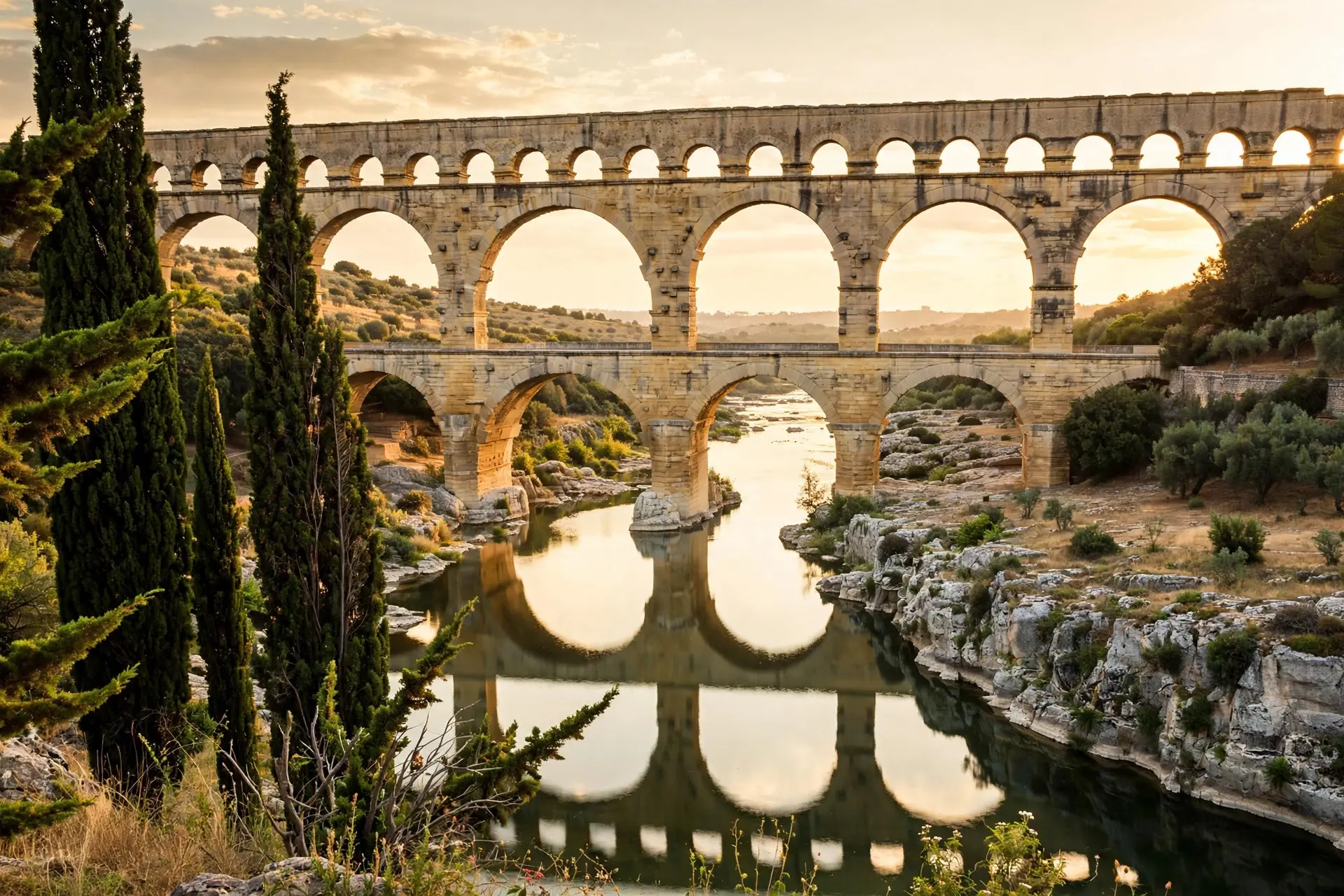
The short answer: the Romans never moved water uphill. Every aqueduct ran entirely downhill, fed by a spring higher than its destination, so gravity did all the work. The Pont du Gard's channel drops just 24 cm per kilometer — across 50 km, that is a total fall of only 12.27 meters.
- The Nîmes aqueduct stretches 50 km (31 miles) from a spring at Uzès to the city, yet falls only 12.27 m (40.3 ft) along the way, an average slope of 24 cm (9.4 in) per kilometer, and delivered up to 35,000 cubic meters (about 9.2 million US gallons) of water a day in its 1st- and 2nd-century prime. (Pont du Gard press kit)
- Writing in the 1st century BC, the engineer Vitruvius set the minimum slope for an open water channel at a quarter of an inch (6.4 mm) of fall for every hundred feet (30.5 m), roughly one part in 4,800, a line so shallow it looks flat to the eye. (Vitruvius, On Architecture 8.6)
- The Beaunant siphon on the Gier aqueduct serving Lyon dropped 123 m (404 ft) down one side of a valley and climbed the other, running 2.6 km (1.6 miles) as sealed pressure pipe. (Roman Aqueducts)
- The deepest siphon known from the ancient world, the Greek-built Madradag system at Pergamon, crossed a valley 190 m (623 ft) deep, generating about 19 atmospheres of pressure in its pipes. (Roman Aqueducts)
- Rome built eleven aqueducts in total, with construction beginning in the 4th century BC and continuing for centuries. (Museo Galileo)
How Did the Romans Move Water Uphill Without Pumps?
They started by cheating: they picked a water source that was already above the destination. Aqueduct engineers looked for strong, clean springs in the hills and then drew one continuous, gently descending line all the way to the city. If the source sat higher than every point on the route, the water never needed to climb, and no pump was ever required. It was not brute force but careful geometry.
Keeping that line on slope was the whole craft. The channel had to fall enough to keep water moving: too flat and it would stagnate, yet stay shallow enough to avoid scouring the masonry. On the ground, Roman survey teams held lines like the Nîmes aqueduct to 24 cm of fall per kilometer for 50 km, the line the Pont du Gard carries across the Gardon river. About 90 percent of that aqueduct ran underground as a masonry channel, cutting straight through hills instead of climbing over them (a tunneling trick Greek engineers had perfected generations earlier), which is why aqueduct routes were far longer than the direct distance: Frontinus, who ran Rome's water supply around AD 97, recorded that engineers stretched the course to follow the land's natural contours and hold the slope steady. Once set, the water simply flowed, day and night, at a walking-pace 0.7 to 1 m/s (2.3 to 3.3 ft/s). For the wider story, see our guide to ancient Roman aqueducts.
How Did Water Cross Deep Valleys?
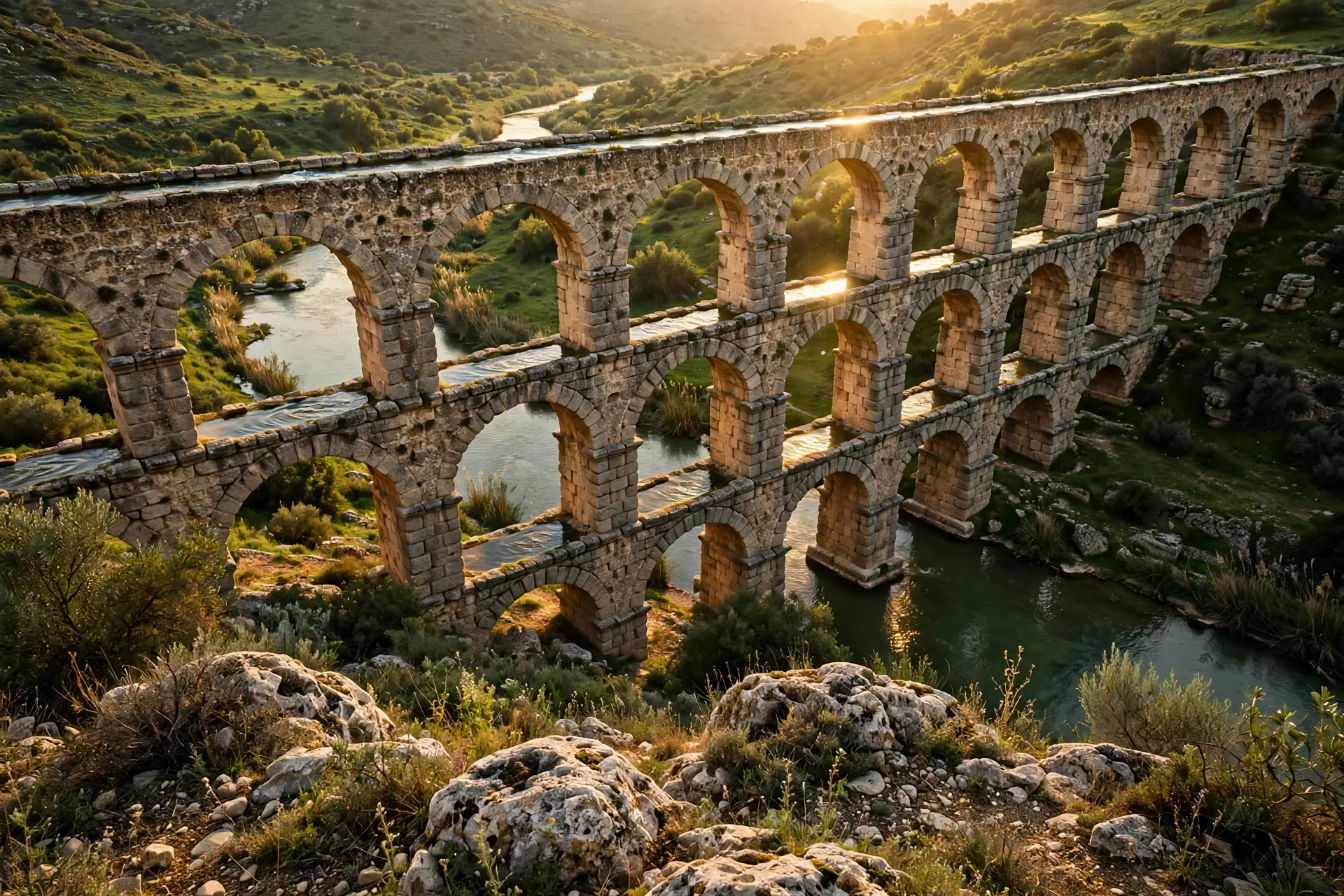
A downhill line cannot hop a valley, so the Romans had three standard answers, and they picked the cheapest one the terrain allowed. The simplest was the long way around: extend the channel along the valley's flanks to hold the slope, even if that added many kilometers. The famous answer was the arcade: carry the open channel across on tiers of stone arches, as the Pont du Gard does over the Gardon river. The clever answer was the inverted siphon, for valleys too deep or wide to bridge. A siphon worked on the plain rule that water finds its own level. Just before the downward slope, water collected in a header reservoir. From there, sealed lead pipes, rolled from sheets and soldered shut in lengths of at least 10 feet (3 m), ran down one slope, across the valley floor, and up the far side into a second reservoir set slightly lower than the first. The weight of the descending water column pushed the flow up the far side, nearly back to its starting height. Vitruvius warned that the valley-bottom section, which he called the venter, had to be long and shallow, and that a sharp elbow would do: the surge would burst the pipe joints. He also called for air cushions and for relief reservoirs every 24,000 feet (about 7.3 km or 4.5 miles) so a break would not drain the whole line. Siphons were common and successful, though expensive. Lead and bronze were costly, the pipes burst and leaked, and a blocked pipe could not be inspected the way an open channel could. Some scholars argue the Pont du Gard exists because enough lead for siphons to carry that volume would have been ruinously expensive.
| Crossing a valley | How it worked | Why engineers chose it | Example |
|---|---|---|---|
| Detour around the valley | Extend the channel along the hillsides to hold the downhill slope | Cheapest where the terrain allowed; added length | Aqua Virgo near Rome |
| Arcade bridge | Carry the open channel across on stone arches | Easy to inspect and repair; limited by safe arch height | Pont du Gard over the Gardon |
| Inverted siphon | Sealed pipes dip down the slope and rise again by water pressure | Crossed valleys too deep for arches; joints had to survive high pressure | Gier aqueduct at Lyon, 123 m (404 ft) deep |
The pressures involved were serious. A 10-meter column of water exerts about one atmosphere of pressure, so the pipes at the bottom of the Beaunant siphon at Lyon carried roughly 12 atmospheres, and the Greek-built Madradag siphon at Pergamon, at 190 m (623 ft), ran at about 19 atmospheres, comparable, the researchers note, to a modern steam engine. In the eastern provinces engineers sometimes swapped lead for ceramic or stone pipes, but leaks stayed a fact of life. The water engineers of Petra faced the same challenge.
Did the Romans Have Any Pumps at All?
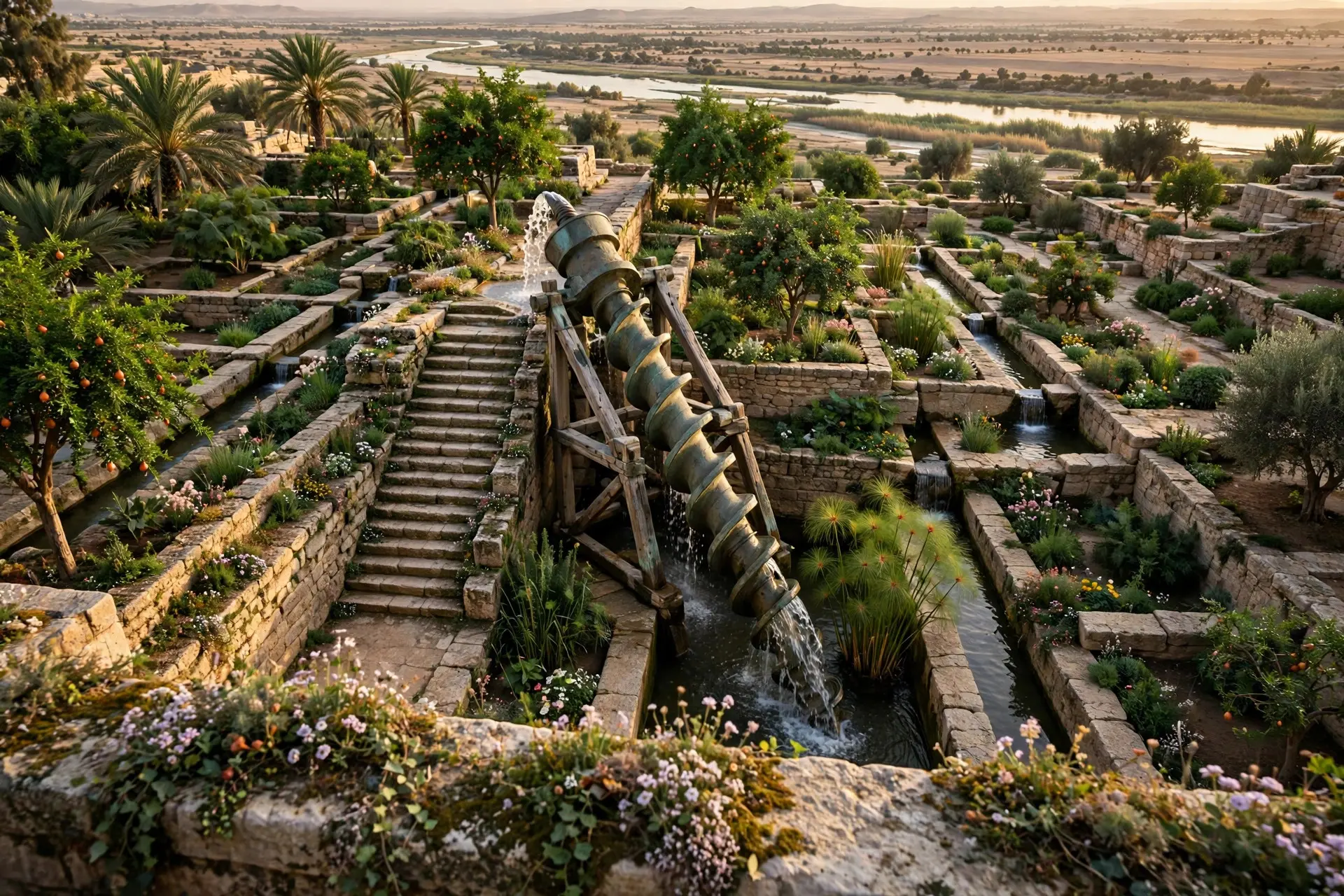
Yes — just not where you might expect. The Romans owned several machines for lifting water, including the noria, a large wheel fitted with boxes or buckets that scooped water as it turned, and the Archimedes screw, a spiral tube wrapped around a rotating shaft that carried water upward as it spun. The Museo Galileo's reconstruction notes that such screws were powered by the feet of a worker and used specifically "to raise water to overcome differences in gradient." These machines served wells, mines, and irrigation: anywhere water had to be lifted out of a hole in the ground. Vitruvius himself wrote that where no spring existed for an aqueduct, "it is necessary to dig wells," and the lifting machines went there. What the Romans never did was put a pump in the middle of an aqueduct trunk line. The whole point of the surveying, the detours, the arcades, and the siphons was to keep gravity doing the work from spring to city without interruption. Lifting happened only at the two ends of the story: out of a well, or up from a cistern into a house.
What Most People Get Wrong About Roman Water
The first mistake is thinking the arches were the aqueduct. The arcades are what survived and what photographers love, but around 90 percent of the Nîmes line was a buried masonry channel. The Romans preferred to hide their water underground, where it stayed cool, clean, and safe from enemies. The second mistake is assuming they knew nothing about pressure. The opposite is true: Vitruvius wrote out the failure modes of pressure pipe and how to avoid them. Pliny the Elder recorded Roman pipes delivering water to the upper rooms of houses, small-scale proof they knew water seeks its own level. The siphons at Lyon, some of them over 100 m (328 ft) deep, show the theory working at full scale. The third mistake is imagining that siphons let water finish higher than it started. They did not. Every siphon discharged into a receiving tank set a little lower than the header tank, and friction stole a little more height besides. The water could dip deep and rise again, but it could never leave the pipe higher than it entered. Gravity always collected its fee. The real trick, then, was never about pushing water up. It was about never letting it need to. Start high, fall a fraction of an inch at a time, bridge or pipe the valleys, and let the planet do the pumping — for centuries, for free. How we made this article: FactSpire researched and drafted it with AI assistance and checked every fact against the sources listed above.
Frequently asked questions
How did Roman aqueducts move water without pumps?
Every aqueduct was built on a gentle, continuous downhill slope from a spring higher than the city, so water flowed under gravity alone. Where the land dipped, engineers carried the channel across valleys on arches or sent it down and back up inside sealed pressure pipes called inverted siphons. Nothing in the system needed a mechanical push.
What is an inverted siphon?
It is a U-shaped pressure pipe. Water from an open channel entered a sealed lead pipe, ran downhill into a valley, then climbed the far slope into a receiving tank set slightly lower than the starting point. Because water seeks its own level, the pressure of the descending column pushed it upward with no pump involved.
Did the Romans understand water pressure?
Yes. Vitruvius, writing in the first century BC, gave detailed rules for pressure pipes: long shallow bottoms called venters, no sharp elbows, and cushions to absorb air surges. The siphon on the Gier aqueduct at Lyon, 123 m (404 ft) deep, shows they designed for roughly 12 atmospheres of pressure at the valley floor.
Why do Roman aqueducts have so many arches?
The arches carry the water channel across valleys and low ground while keeping its gentle downhill slope. But they are the exception, not the rule: around 90 percent of the Nîmes aqueduct ran underground as a buried masonry channel. Most of the line was invisible from the surface.
Sources
- Pont du Gard Press Kit, Pont du Gard (EPCC)
- Aqua Clopedia, a picture dictionary of Roman aqueducts: Siphons, Roman Aqueducts (romanaqueducts.info)
- Vitruvius, On Architecture 8.6, Lexundria
- 3. Science and technology of water, Museo Galileo
- Roman aqueducts: Deepest siphons in Roman Aqueducts, Roman Aqueducts (romanaqueducts.info)