Pampas of South America: Inside the World's Breadbasket
The Pampas' dark soils feed the world — Argentina's beef, soy, and wheat. Explore the grassland's fertility, the gaucho, and what's vanishing.
Key takeaways
- The Pampas cover more than 1,200,000 square kilometers across Argentina, Uruguay, and Brazil's Rio Grande do Sul, making them one of the world's largest temperate grasslands.
- Their fertility comes from deep, dark Mollisol soils built up over millennia by decomposing grasses, watered by 600 to 1,200 mm of evenly distributed rain each year.
- Cattle introduced by the Portuguese in the 1550s roamed free on the grass, giving rise to the gaucho — the horseman whose culture still defines Argentina's rural identity.
- Today the Pampas are a global agricultural powerhouse, leading the world in exports of soybeans, wheat, and beef, though intensive farming has cost the region much of its native grassland.
The Quechua word pampa simply means "plain" — and plain is exactly what you get, in almost absurd abundance. The Pampas stretch across more than 1,200,000 square kilometers of southern South America, a temperate grassland so vast and so flat that the only interruptions are two low ranges of hills near Bahía Blanca and Tandil. Beneath the swaying grasses lie some of the most fertile soils on Earth, and on that foundation a nation built its wealth, its cuisine, and its national character. This is the story of a sea of grass that became one of the world's great breadbaskets.
Why is the pampas soil so fertile?
The secret is buried. Pampas soils belong to a class called Mollisols — deep, dark earth rich in organic matter, built up over millennia as generation after generation of perennial grasses grew, died, and decomposed into the ground. The thick, black topsoil often runs several feet deep, holding water and nutrients in a stable root zone that needs far less artificial fertilization than farmland elsewhere in the world. It is, by most measures, among the most naturally productive soil on the planet. The climate does its part. The Pampas receive between 600 and 1,200 millimeters of rain per year, distributed fairly evenly through the seasons, with average temperatures around 18°C. No long dry season starves the grasses; no harsh winter freezes them out. Grasses of varying height carpet the region according to how much rain each area receives, trees appearing only along watercourses. The result is a natural system that grows food on its own terms — first grass for grazing animals, and, once the plow arrived, grain for the world. It is a different kind of abundance from the mirror-flat salt flats of Salar de Uyuni, another South American plain, but it is a plain built for life rather than for emptiness.
How did the gaucho become the soul of a nation?
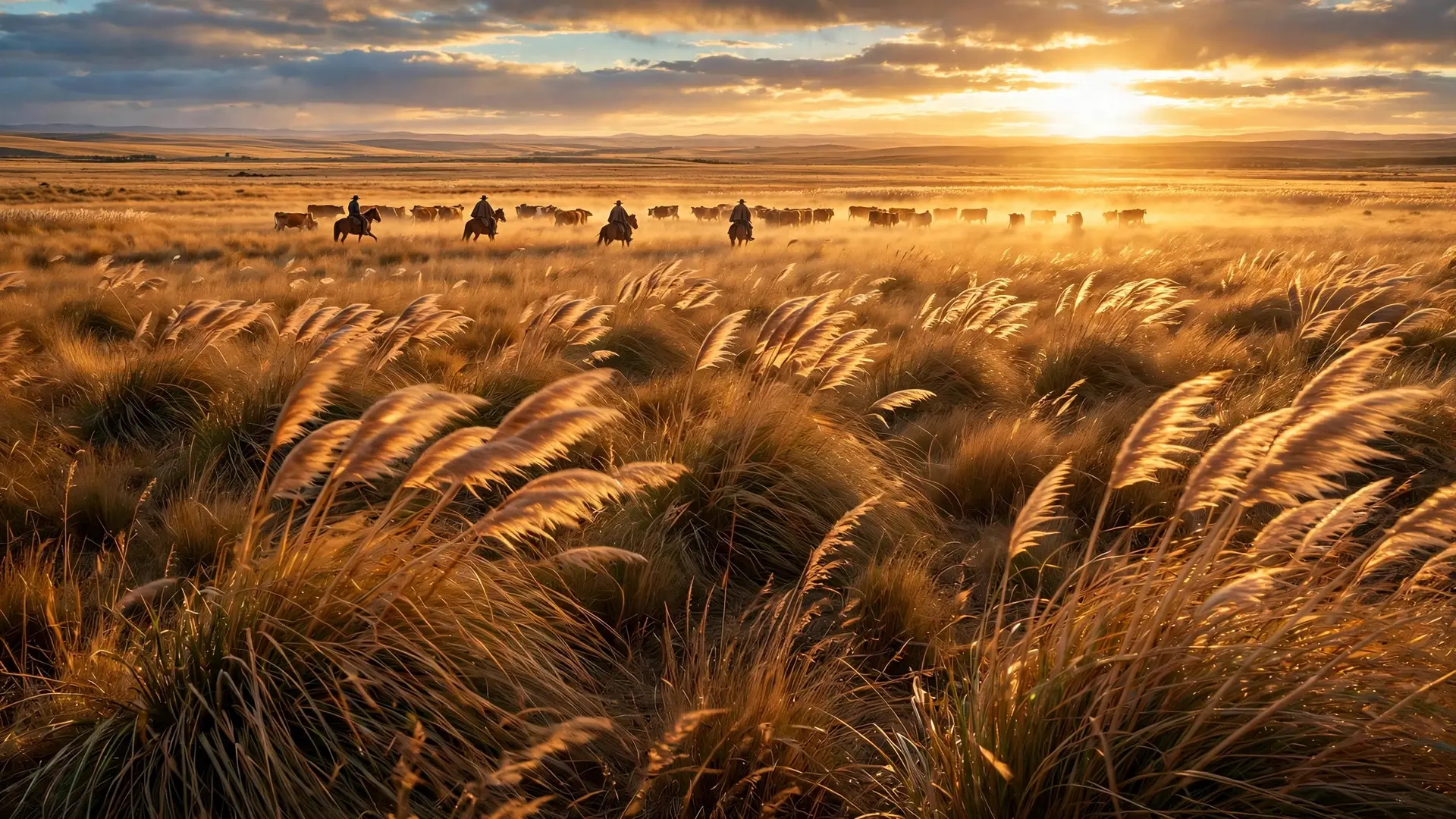
Cattle were not native to the Pampas — they were introduced by the Portuguese in the 1550s, and they found paradise. The herds multiplied across the unclaimed grasslands until vast free-roaming herds covered the plain. Through the colonial era, economic life was simple: stock raised almost wild, harvested for hides, tallow, and dried beef. And astride those herds rode the figure who would come to define the region — the gaucho, the Argentine cowboy.
The gaucho's world was the treeless horizon. A master horseman, he worked the herds with the boleadoras — weighted cords thrown to entangle a running animal's legs — and the facón, a long knife carried at the belt. His diet was beef cooked over open fire, the asado, washed down with bitter yerba mate. His life was independence itself: no fences, no clocks, nothing between him and the sky. Through the 18th and early 19th centuries, the gaucho was the dominant figure of the Pampa, and his legend hardened into Argentina's national symbol — the embodiment of freedom, skill, and a distinctly rural identity. That world began to change in the second half of the 19th century. A growing European appetite for food, plus new railroads linking the interior ranches to the Atlantic ports, drew waves of immigrant farmers — mostly Italian, Spanish, French, and German — onto the plain. The unfenced grass was divided, the plow turned the soil, and the gaucho gradually yielded to the farmer. The railways that carried grain to the coast also carried away the open frontier. Yet the gaucho never quite left: his image survives in festivals, music, and the asado itself, which remains Argentina's defining social ritual.
How did grass become one of the world's breadbaskets?
The modern Pampas are an agricultural machine of global significance. The region divides roughly by rainfall: the drier western Pampa favors wheat and livestock grazing, while the more humid eastern Pampa grows corn, soybeans, and sunflowers, and supports dairying and vegetable farming. Argentina's main export is soybeans, grown on around 17 million hectares, followed by wheat on nearly seven million — and most of both comes from the black soils of the Pampa, alongside the beef industry the region has fed for centuries. The transformation was driven by scale and technology. The flat terrain allows massive mechanized farms and efficient transport to the coastal ports; no-till farming and modern seed varieties have pushed yields ever higher. Argentina, Uruguay, and southern Brazil together now anchor a export economy built on this grassland: soybeans, corn, wheat, and beef flowing out through ports like Rosario and Buenos Aires to markets across the world. Few regions convert sunlight and soil into food so efficiently. The Pampas earn the "breadbasket" title honestly — they feed far more people than they hold.
What are the main products of the Pampas?
If you eat bread, beef, or anything cooked in soybean oil, you have probably tasted the Pampas. The region's product list reads like a commodity trader's watchlist:
- Soybeans — Argentina's top export, grown on around 17 million hectares, most of it on Pampas soil.
- Wheat — the second pillar, on nearly seven million hectares, concentrated in the drier western Pampa.
- Corn — the humid eastern Pampa's cash crop, alongside dairying and vegetable farming.
- Beef — the historic product, from the cattle culture that created the gaucho; Argentina remains one of the world's top beef exporters.
- Dairy and vegetables — smaller but significant, clustered near the big cities. Geography sorts the list: the drier west favors wheat and grazing, the wetter east grows corn, soy, and sunflowers and supports dairying. From the ports of Rosario and Buenos Aires, these goods flow to markets on every continent — the concrete answer to why the Pampas earned the "breadbasket" name.
What is the sea of grass losing?
There is a cost to the harvest. The shift from traditional cattle ranching to intensive monoculture has steadily replaced native grassland with endless fields of soy and corn. Researchers and conservationists point to soil compaction, declining biodiversity, and the quiet disappearance of the original grassland ecosystem — a biome that once supported around 400 bird species and a hundred species of terrestrial mammals, from the flightless rhea to the pampas fox and the armadillo. Like reclaimed farmland in the Netherlands, this is a landscape remade entirely by human hands — only here, the remaking erases what was there rather than building on water. The contrast with places like the Atacama Desert is instructive. The Atacama is protected by its own extremity; almost nothing can exploit it. The Pampas' tragedy, if there is one, is that they are too useful — too flat, too fertile, too perfectly suited to feeding the world to be left alone. Efforts toward more sustainable practices, including crop rotation and conservation of remaining grassland fragments, are underway, but the balance between output and preservation remains the region's defining challenge. Stand in the middle of the Pampa today and the horizon still runs unbroken in every direction — a green sea that rolls to the edge of the world. It is the same view the gaucho saw, and the same soil that fed the cattle, and the wheat, and the ambition of a young nation. Grass did all of this: thousands of years of it, growing and dying into the dark earth, building a foundation rich enough to feed continents. The sea of grass is no longer quite the wilderness it was, but it remains one of the great landscapes of the planet — and one of the most important.
Frequently asked questions
Where exactly are the Pampas located?
The Pampas stretch across the Argentine provinces of Buenos Aires, Santa Fe, Córdoba, Entre Ríos, and La Pampa, all of Uruguay, and Brazil's southernmost state, Rio Grande do Sul. The only relief is the low Ventana and Tandil hills in Argentina.
Why is the soil of the Pampas so fertile?
Thousands of years of grass growth and decay built up deep, dark Mollisol soils exceptionally rich in organic matter. Combined with 600 to 1,200 mm of well-distributed rainfall, this makes the land ideal for both crops and pasture.
Who were the gauchos?
Gauchos were the skilled horsemen of the Pampas who herded free-roaming cattle in the 18th and 19th centuries. Their culture of independence, beef-centered cuisine, and horsemanship became a defining symbol of Argentina.
Sources
- pampas, Infoplease (Columbia Electronic Encyclopedia)
- What Is a Pampa? Exploring the South American Grassland, Biology Insights
- Argentina's soybean area set to expand in 2026/27, The Pig Site